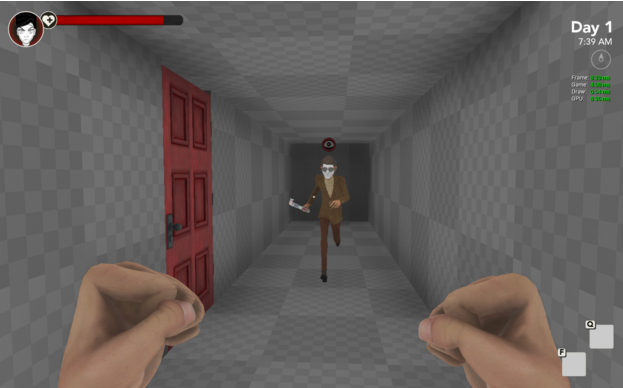
Sunday, December 20, 2015

The Door Problem

Liz England explains Game Development in terms of doors. A sample:

Premise: You are making a game.
  • Are there doors in your game?
  • Can the player open them?
  • Can the player open every door in the game?
  • Or are some doors for decoration?
  • How does the player know the difference?
  • Are doors you can open green and ones you can’t red? Is there trash piled up in front of doors you can’t use? Did you just remove the doorknobs and call it a day? [snip]
And then who does what:

  • Creative Director: “Yes, we definitely need doors in this game.”
  • Project Manager: “I’ll put time on the schedule for people to make doors.”
  • Designer: “I wrote a doc explaining what we need doors to do.”
  • Concept Artist: “I made some gorgeous paintings of doors.”
  • Art Director: “This third painting is exactly the style of doors we need.”
  • Environment Artist: “I took this painting of a door and made it into an object in the game.”
  • Animator: “I made the door open and close.” [snip]
The full post goes on at much greater length; check it out.

"Door" is not a metaphor. We spent a bit of time earlier this year talking about how the player would know which doors open, which are locked, which are locked and only unlockable with a special item, and which are purely decorative.

Oh, and Studio Cypher made the first part into a poster:


Friday, December 18, 2015

We Happy Few Update!


This week I’ve been continuing to work on our gigantic Encounters spreadsheet. Level designers contribute the situation and objective: do this, get that. I try to figure out who the characters in the encounters are, and why they want those things, essentially retro-engineering from the gameplay. I then write dialog, if needed, as well as tooltips, journal entries, and lore. I’m most of the way through fleshing out the encounters for the first Garden District island. So GD1 is now, at least in our design, populated with all sorts of strange characters that the player can interact with in ways more challenging than clonking them on the head and taking their stuff.

We’re also working on the very early parts of the game, where we’ll spawn encounters that help define the world, and incidentally show new players how to do basic things, like clonk characters on the head and take their stuff.

In my copious free time, I’m also writing a later player character’s version of every single thing Arthur says. This character has a very different point of view on her interactions, and I don’t think she’s as inclined to apologize for, say, clonking people on the head, or taking their stuff.

Find the rest of the team's update here.

Wednesday, December 16, 2015

I Want to Sue!

Q. I am filing a lawsuit against a movie studio who I believe stole my pilot for their movie [...].  I have a copyright from 2010, and the movie was released in 2012.

Would you know of any good entertainment lawyers...?


A couple of things to consider: If their movie was released in 2012, it was presumably shot in 2011, which means there would have likely been a script in 2009-2010. Most projects go through several rounds of rewrites; development typically goes on for years.

There are many many scripts with similar elements. Many writers have similar ideas. Some ideas are just in the air. Some follow from the subject material. Can you prove that any specific person at the studio read your script? For example, Art Buchwald was able to sue Paramount over Coming to America because they’d signed a contract with him to work on the project.

If you did submit a script to a studio, they almost certain had you sign a release form. Release forms are not 100% effective (they are arguably unconscionable), but they are written specifically to insulate companies from "you stole my idea" suits.

Actually, you can legally steal any idea. Ideas are not copyrightable. You can only copyright the expression of an idea:  plot, characterization, dialog, unique action sequences. You would have to prove that their movie has so many specific similarities to your script that they surely must have used your script. 

Bear in mind: movie studios have lots of very fancy lawyers on retainer, who do nothing all day but fend off lawsuits. Unless you can invest $100,000 in your lawsuit, you’ll probably get swamped by their legal team no matter what the merits of the case are.


(I am not a lawyer; this is not legal advice.)

Friday, December 11, 2015

We Happy Few Update!


We’re making a big push to populate our procedural world with encounters, so I’m shifting my efforts from recording barks and cutscenes to fleshing out encounters. David has written a huge gigantic spreadsheet detailing all sorts of shenanigans you can get into on our various islands. My job is to take his gameplay specifications and make them into encounters that feel meaningful in addition to being fun challenges. Writing dialog is easy (well, I’ve been doing it for 25 years); the hard part is figuring out who the NPC we’re meeting is, what his unique agenda is, and making sure that is revelatory of our world, our lore and our theme.


Friday, November 27, 2015

We Happy Few updates

I split this week between editing barks, and working on narrative content for the opening scene. Although the full narrative won’t come out until the game’s released, the game will start with a bang -- a bang full of details about Arthur, and about his world, and what he needs to do and why he needs to do it. There will be gameplay, and there will be narrative cutscenes, and there will be narrative audio that responds to the gameplay.

So I’ve been building that audio; and I’ve been filling Arthur’s opening with characters and items, so that if the player wants, he or she can not only explore a bit, s/he can unravel some mysteries about who they are and what they’re up to.

By “filling,” I mean writing lists of things that could be in places. Then I discuss them with the art department, and we talk about what can be done and what can’t. (It turns out we could do Uncle Jack bobbleheads! But we thought that was too Fallout-y/Borderlands-y.)

The more we develop the characters in the opening, the more likely we’ll want to see them again later...

Find the rest of the update here, including a neat long post by our composer, Nic Marquis.

Thursday, November 26, 2015

It's not TV, it's streamed entertainment meant to be watched at your own pace

We've been enjoying Jessica Jones on Netflix. After that, we have Man in the High Castle on Amazon Prime. Last month, we ate up Alpha House.

When HBO started making its own series, it had the slogan, "It's not TV, it's HBO." This wasn't just a slogan. It was an accurate statement about genre. A pay cable show has a different mandate than a broadcast or basic cable TV show.

TV shows are about ratings. The product is not the show, it's the ads. The show is there to get you to watch the ads. So TV shows are about (a) number of eyeballs, and, to a lesser extent, (b) demographics of the eyeballs. (Good demographics kept The West Wing on the air in spite of less-than-stellar ratings.) TV shows are built to keep you watching over the commercial break, and over the weeklong break between shows. They're all about cliffhangers and act outs.

In pay cable, the show actually is the product. HBO shows are successful when they cause viewers to subscribe and stay subscribed. HBO doesn't care if you watch all their shows, or just one show, in any given month, so long as you love that one show so much you're willing to cough up $15 to see it.

But HBO shows still roll out once a week. Eventually you can watch them all in a few days when there's a marathon, and after that there's the DVD, but they're built to be watched one a week. Even in a soap opera like Sopranos or Sons of Anarchy, each episode needs to work on its own.

Along comes streamed binge-watching. Netflix shows do not have to be built to be watched one a week. Who on Earth has that kind of patience? It's all I can do to watch only one Jessica Jones a night.

Now, Jessica Jones is written by (excellent) TV writers, so its episodes do work on their own. They reach an emotional climax at the end. The storytelling slows and the camera goes in for a closeup or out for a wide shot, and you know it's time to go make that sandwich.

But it doesn't have to be made that way. Melissa Rosenberg only has to keep you away from the remote for 20 seconds. If you just sit there, the next episode will stream. She doesn't have to tell an episodic story. She could just tell a 10 hour saga. That's how quite a few people will experience the first season of Jessica Jones, after all.

Network research shows that the average prime time TV viewer watches one out of four episodes of shows they like. So much as the writers like to craft a whole season, it's not being experienced that way. HBO is appointment TV (or non-TV) so it's more likely people will catch most of the episodes. But Melissa Rosenberg knows for sure that you're going to watch the episodes in the right order, and you won't miss any. She can also assume that you've watched the previous episode pretty recently.

Unlike TV, you are probably only watching one Netflix show at once. We'll watch Jessica Jones; then we'll watch Man in the High Castle.

We need a new name for whatever this form is. It's not TV, after all. A lot of millenials don't even own TVs. They watch their TV shows on their computers.

These shows have as much in common with really long movies on Netflix as they do with TV shows. If I were watching the Lord of the Rings movies, I'd probably watch them in 45 minute chunks, or maybe I'd watch them all over a weekend.

We need another word for them, or "TV" is going to become one of those odd words like "mixtape" that have lost their physical referent and just mean the function that that physical thing used to have.

Whatever we call them, they're going to change TV as much or more than pay cable ever did.

Tuesday, November 17, 2015

Against Warren Spector!

Oh, not really. He's an important figure in the history of video games. He's made important innovations and great games. We're lucky to have him.

Warren Spector
But I disagree with Warren Spector's evangelism for blank player characters and against linear narrative in games.

For those of you who don't know the name (you're not in the game biz, are you?), Warren Spector is famous for the Deus Ex game franchise, which gave players different ways to confront each challenge. You can stealth your way through a Deux Ex game. You can shoot your way. You can talk your way through a lot of it. You can ghost your way through it, being so stealthy that no one even knows you were there. Point is, you have "problems" that can be solved different ways, not "puzzles" that you must solve the way the designer intended.

I met Warren yesterday because I was asked to interview him as part of his master class on Game Narrative. It was to some extent an expanded version of this GDC talk of his.

After the class, we got to arguing, a bit. Not unpleasantly so, because we both agree (as New Yorkers tend to) that the shortest path to the truth is an argument. 

Warren believes that games should strive to give the players room to express themselves through their gameplay. So if you like killin' dudes, you should be able to do that. If you like stealthing, you should be able to do that. 

And that's a great way to make a game. (Assuming the studio can afford it.) 

But Warren draws the conclusion that, therefore, the game designer must not tell you too much about the player character. We can't say the main character is shy; what if he beds everyone he meets. Can't say he's kind; what if he shoots everyone? Can't say he's bloodthirsty; what if the player is doing a nonlethal playthrough? The personality of the player may be at odds with the personality of the player character.

Underlying his point of view is the axiom that the player character isn't really a character, he's you. He's a blank slate on which you write your own personality. So on Deus Ex, for example, the voice actor was literally asked to speak in a monotone, sort of robotic voice.

It is a common notion in games that the player is you. And therefore, in the last Dragon Age, although you are always the savior of the world, you can be different races and different character classes, and you can call yourself by different names, and you can make your character look more or less like you. Fallout 4, same thing, you pick a name and a gender, you pick or mold a face, etc. These games give you room to express yourself buy picking who you are going to be. So avoid giving you any information that might contradict that. 

But I don't want to be the character. I want a relationship with the character. I want to know who he or she is. I'm not going to care about him or her unless I do. 

The many successful narrative games with well-defined heroes suggest that I'm not the only player who'd rather have a relationship than "be" the main character.

Of all media, only games let you actively join the fun. You can identify with the hero of a book, but you can't change what he does. You can interpret that R2D2 and Chewbacca are the real heroes of Star Wars, but Luke is always going to blow up the Death Star. You can't change who Harry Potter is. 

An axiom of Warren's, I think, is that because there are certain things only games can do, games should only do those things. 

Now, Warren acknowledges that games that don't let you express yourself are not only common, but often very fun, and indeed, he likes playing Telltale Games' Walking Dead; he's the first to admit he has the Walking Dead games on his laptop. 

But he doesn't want to make such games;and he feels these games are inherently inferior. He feels they're not doing everything that games can do. He calls them "Low Expression" games, as opposed to "High Expression" games like Madden Football and The Sims, where the outcome is all the player's. 

I don't buy purist arguments in general, and I don't buy this one. 

One way we engage with the main character in a game is by making choices for him or her. But it is not the only way. There is another. 

See, in movies and TV we learn the exact opposite idea about main characters. They should be as distinct, and precise, and human as possible. We should give him or her specific flaws and a specific past. 

But won't that alienate people who are different from the main character? 

Why, no, because we have the capacity to engage with other people.

Normal human beings have what are called "mirror neurons." They fire when we see another human being go through pain or joy or injustice or whatever. When we see someone take a bad fall, we don't just intellectually know that's going to hurt; we actually feel a bit of the pain. We feel it, we don't think it. Our nerves are actually firing. 

So when Indiana Jones gets the snot knocked out of him, we feel it. And when he kisses the girl, we feel it. 

And when the very disabled kids in this video feel joy, well, I defy you not to feel it too.  (Trigger warning: disabled people feeling joy.):


But our mirror neurons only fire when the individual feeling the feeling is real to us. We can care about a dog or an alien, but our mirror neurons don't fire when a ten ton weight falls on the head of a cartoon character. We laugh. Hah hah, ten ton weight!

The less distinct, and precise, and well-observed, and flawed, and real a character is the less we care about him or her. Cartoons make us laugh, but the more cartoonish they are, the less we are really moved by their predicaments. "Everyman" characters get tedious fast. Saints get tedious immediately, in a story.

That's why, in Casablanca, we care about Rick, not Victor Laszlo. Victor Laszlo is set up as a genuine hero. He gets the crowd to sing the Marseillaise. He's escaped from concentration camps. He doesn't get bent out of shape about how his beautiful young wife obviously had an affair while he was in one of those camps. 

He doesn't feel real. 

Meanwhile, Rick is wounded, and cynical, and angry. He sticks his neck out for no man. He's a bastard to the woman he loves; he calls her a whore (that's what that "tinny piano" crack means). 

And we engage with him, and we care about him, not the hero-saint in the white jacket.

I submit that the reason The Last of Us worked so well was because both Joel and Ellie were very real, flawed people. Ellie was mouthy and sullen and ungrateful. Joel was cold and angry. 

So when I played Joel, I cared about Joel. I am not Joel. I do have a daughter, but she was not killed by soldiers during a zombie pandemic. But I can relate.

And when I played the kid in Papo & Yo, well, I am not a kid from a Latin American ghetto. I'm a privileged white dude from the Upper West Side.  But I had a relationship with that kid. He was real to me. I can relate to his worries about Papo. 

So, I believe, even in games, Warren, we storytellers create emotional engagement by creating very specific and real and human-feeling player characters. I think when people play Arthur in We Happy Few, they're going to feel what he's feeling. They are going to feel engaged, not because he's a blank slate, but because he isn't one, and because Alex Wyndham brings all of his amazing wit and humanity to the role.

And I don't feel that much engagement with Corvo in Dishonored. I don't feel his pain. I enjoy the fantasy of being a magical ninja, but how many players feel the pain when their character is shot up and bleeding? I don't really engage with Captain Shepherd in Mass Effect because he's a heroic stiff. 

I think there are two ways to engage with player characters in games, and they are both one hundred percent legit. 

I was in a Live Action Role Playing group in the 90's. Some people used their characters to play an upgraded, upgunned, richer, faster, sexier version of themselves. Some people used their character to play someone who was decidedly not themselves.

See, playing someone who is not you can be freeing. A lot of people play games for escapism. If you're playing a version of yourself, you're not escaping as far as you are if you're playing a well-defined character. Playing John Marston frees you to be an Old West gunslinger whose solutions to most problems is shooting someone. Playing Ezio frees you to assassinate people. 

When you read a novel, you can imagine your way into Huck Finn's skin, or Ebenezer Scrooge, or Ishmael, or Elisabeth Bennet. Or you can watch a movie and imagine your way into Han Solo's vest, or Slayer Leia's bikini. 

Why do you think people cosplay? 

Warren's argument is that only games can allow you to be yourself in imaginary circumstances. But games can allow you to be someone else. Just because other media do this doesn't mean games shouldn't.

Games are becoming a dominant art form. By that I mean the form to which artists turn by default. In Shakespeare's time, if you wanted to express yourself, you wrote a poem or a play. In Jane Austen's time, you wrote a poem or a novel. In the early 20th Century, you wrote a novel or a screenplay. In the tail end of the 20th Century, you wrote a screenplay or a TV show. Now my writer friends want to write cable TV shows, and only if the idea doesn't lend itself to that do they consider writing a movie, and only if that's just not plausible do they consider writing a novel. 

Sure, people still put on plays. But it's a niche form. You'd only write a play if that idea really only lends itself to people performing in a ritual space with the audience present. 

In Shakespeare's time, people wrote poems at the drop of a hat. These days you'd only express yourself in poetry if that's really the only way you could communicate what you have to say. (Or, if you have very little to communicate, and you're afraid of being found out. Contemporary poetry is great for that.) 

If you're working in a niche art form, you have to justify yourself. Why is this a play? Why is this a poem? If you're working in a dominant art form, you don't. In Shakespeare's day, of course you were writing poems. Every educated person did. Good Queen Bess wrote poetry herself. 

Theoretically We Happy Few could be a TV show. Theoretically it could be a movie. But games are a dominant art form, so we don't go to TV first. We make a narrative game.

The underlying assumption behind Warren's argument is that games need to justify themselves by doing the things that only games can do. I'm saying games don't need to justify themselves at all. That's for niche art forms; for media that are past their sell-by. Sure, in some sense, The Last of Us could be regarded as a movie in which you kill zombies in order to advance to the next scene. So what? The guys who made it didn't want to make a movie. They wanted to make a game. Dominant art forms don't need to justify themselves. 

And to the extent The Last of Us is a game, it takes advantage of that additional bit of identification we get with the hero that passive entertainment can't give. Because you do have a different relationship with a player character than you do with Mr. Hiro Protagonist in a novel. You are engaging actively in the gameplay, even when the storytelling is linear. So when Joel makes his big choice at the end of the game, you are a little bit closer to owning that choice yourself. Which makes it all the more shocking.

There is nothing wrong with games that are the artistic expression of the game maker, rather than the expression of the player. There is nothing wrong with Papo & Yo. 

There better not be, because while We Happy Few will have expressive gameplay, the narrative is made up of things I wrote and directed and edited, and the player can't change any of them. The interlocking stories only end one way. The player characters are as well defined as I know how to make them. They make choices for you that I made for them. You will feel for them, you will be pissed off at them, you will identify with them, I believe, not in spite of their flaws but because of them. And maybe you'll identify with them even a little more because you play them. 

A story is a:
  1. Character we care about
  2. who has an opportunity, problem or goal
  3. who faces obstacles, antagonists, and/or a personal flaw
  4. who has something to lose
  5. and something to gain.
You can't tell a strong story if you refuse to tell your audience who the main character is. 

So I believe we can call some games Player Expressive games, and some games Designer Expressive games, and they're both valuable and righteous and good.

So I call shenanigans on Warren, innovator and cool game-maker that he is.

Shenanigans, I say!

Friday, November 13, 2015

We Happy Few Update!

Last Thursday and Friday I was in the recording studio with the intrepid José (our audio producer), recording a Doctor and a Bobby. We have roughly doubled the number of things Doctors and Bobbies can now say, although we (and by “we,” I mean Marc) have to integrate them into these characters’ AIs. When, exactly, does each character say each sort of line?

Today, I was in the studio recording Alex Wyndham and Katherine Kingsley, who were in London. Great actors are magic. They take a line that you heard in your head, and make it their own. Sometimes, you find yourself caught off guard by a line they perform, even though you are reading the words on the page, which you wrote, even as they do it. It’s a sure sign that the performance is amazing when you burst out laughing in the middle of the recording session.

Poor Katherine Kingsley! I auditioned her last year, and she was brilliant. And then I went more or less radio silent. She’d ping me, and I’d say, yes, we truly intend to record you, but I have to do x and y characters first. I did fairly long auditions with her over Skype, to the point where I wouldn’t blame her for wondering if I’d just recorded her audition and was using it in the game (which is apparently a Known Abuse of Actors).

So when she finally got the call, I imagine she probably went through a moment of, “wait a second, these guys were for real?”

She turned out to be every bit as superb as I hoped. She’s a part of the opening scene, which we’re working on now.

Now comes the work of cutting out sound takes. It takes much longer to cut out the sound takes from an hour’s session than the hour itself. Sometimes I have to listen to each take a few times to decide which one I want. Sometimes I have to construct better takes from two takes with good parts.

The other thing I did: rewrote the opening scene. The opening scene of Arthur’s playthrough, which is the opening scene for the game as well, has been sitting on my computer in various forms for well over a year. But now the team is all working on it. This week David and Vincent added yards of new gameplay to it. So, Arthur has to respond to all these new challenges in some way, right? He has to say something Arthur-y. So, two days before my recording session, I was writing new things for Arthur to say.

I can’t tell you when all this new content will make it into the game, but I hope you dig it!

Find the rest of the team's update here.