


Wow, it's been a little while since I posted last. And it's looking to be a busy Spring.
SOUTH OF MIDNIGHT dropped! It looks great:
I worked on South of Midnight for about three years as the first narrative director, before moving to Highdive (aka Netease) and FRAGPUNK. It was and is an extremely ambitious project: a Southern Gothic third-person adventure story set in the Deep South, about a young Black woman who discovers the creatures of Southern folklore, and her own magical powers. At one point I think I might have suggested that we were about to go running with scissors through a cultural minefield.
I'm excited to see if Compulsion pulled it off! You can check the game out on Xbox GamePass as of April 8th.
Oh, yeah, FRAGPUNK. FRAGPUNK dropped last month!
This is a multiplayer shooter I've been the Narrative Lead on since I left Compulsion. We have terrific gameplay, a fresh mechanic, and outrageous characters who are a hoot to write.
And... my book drops April 30. The best place to buy it seems to be the publisher's site, where it's about US $50 (minus 20% off through April!). It's about, what else, game writing. If you liked my books about TV writing and movie writing, you'll probably like this one, too. And if you haven't, you'll probably like it anyway! I mean, you're here, aren't you?
(Spoilers for Shogun)
Episode 7 of Shogun sees the wily central Japanese character Toronaga surrounded, defended only by a weakened garrison, at the mercy of his enemies. The Regency Council has summoned him to Osaka, where he will surely be commanded to commit seppuku. It appears he has no choice but to obey.
But the episode is called "A Stick of Time." That refers to the length of time requested by the madam of a high-class "tea house" (brothel), Gin, to talk to Toronaga: the time it takes for a stick of incense to burn down.
What is so important about this interview, that it gets the episode named after it?
Gin has a request. Toronaga is building a new city, Edo, in the Kanto Plain. She has a tea house in the woods. She wants permission to create an entire district of tea houses in Edo, to give her people a world to belong to.
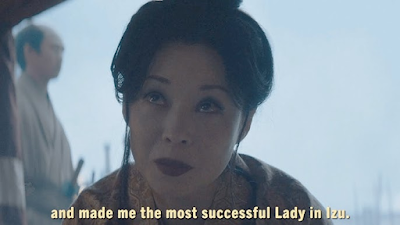 |
| "My hardships taught me ambition and guile, and made me the most successful Lady in Izu, just as your hardships made you into the cunning man you are today." |
Toronaga is dismissive. He does not expect to live long enough to give or deny her permission.
She says, in the nicest possible way, don't bullshit a bullshitter. How has the wily Toronaga been caught with his pants down. Did his scouts forget to tell him an army was surrounding him?
He says, you think I let this happen intentionally?
She says, oh, hey, what do I know, "I'm just an old whore."
One problem in dramatic writing is dealing with characters who have every reason to conceal what they are thinking. How does the audience know? In this case, how does the audience know to watch episode 8, given that it is presumably about Toronaga and all the characters we love being killed?
You can, of course, give the secretive character someone to unburden himself to. But in Toronaga's case, he is too wily to unburden himself to anybody, at least anyone we know well. It would not be in his interest to tell his butler what his plans are.
Instead we have this madam telling Toronaga, "You're up to something, aren't you?" so Toronaga can say "who, me? Never." Which tells the audience, Toronaga is up to something. They can safely watch episode 8 to see how he gets himself out of this one.
(Act 1: get your hero up a tree. Act 2: he tries to get down from the tree, but only ends up further up the tree. Act 3: he escapes the tree.)
When you have a secretive or dissembling character, consider having someone else say what is on his mind. The audience won't know if they are guessing correctly, which creates much more suspense than if the character reveals himself to someone trusted.
Of course, if you know a bit of Japanese history, you know that this district will be built. It will be called ukiyo-e "the floating world," and artists such as Hiroshige will make a zillion beautiful woodcuts of it. You may also have figured out by episode 7 that Toronaga is based heavily on Tokugawa Ieyasu, who outmaneuvered his enemies to make himself... Shogun. You know that Edo will later be named Tokyo (literally "Eastern Capital"). So his eventual success will not come as a complete surprise. But this is a fictionalization, and for all we know, Toronoga's end is not Tokugawa's end.
So the scriptwriters (and perhaps the novelist -- I haven't read the book in decades) trot out Madame Gin to pull the curtain back just a bit on Toronaga's machinations.
Nicely done!

A civilian friend sent me an opinion piece about video games from the New York Times. It covers the move to live, free-to-play games over single-player games you play once and move on from. Which, predictably, it bewails.
Fair enough. Live games do make it harder to release a new game. The "next Fortnite" is probably also Fortnite.
On the other hand, I'm working on a live game that releases March 6, and I'm happy that I won't be unemployed on March 7 (inshallah). And if people didn't want live games, they wouldn't buy them.
The article is off base on two points. One, yes, some games do have a lot of sidequests that can come off as grindy chores, but then also, that's an issue that game devs have identified and rejected. We often have conversations like, "We're not going to ask the player to collect one thousand feathers."
The other is that it's ridiculous to say games used to be better. Of course the MOMA is collecting old games. Museums collect old things, after their worth has been proven. There are amazing new games all the time, just as there was filler and trash twenty years ago. Games like Disco Elysium, Balatro and Hades are future classics. The present always looks worse than the past, in any medium, because we only remember the good stuff from the past. Not all ancient Greek epics were Homer. It's just, most ancient Greek epics have gone the way of the ancient Greeks.
As I discussed in my first book (and maybe my second?) I think that the best way to develop a story, any story, is to tell it over and over, to different people, without notes. This gets you a bunch of things:
a. You can tell how it holds together. If you can't remember what comes next, then the story logic needs mending
b. You can immediately tell if your listener is bored. People who read your writing have time to prepare a lie, but if their eyes glaze over, they're bored
c. You may come up with something better as you tell your story on the fly. Writing a story down freezes it, but until then, it's a fluid, living, growing thing.
So here's Yannick Trapman-O'Brian, immersive experience-maker, on Reality Escape Pod S8E7:
"I wish upon everyone an intoxicated audience. The clarity it requires of you, someone just looking you full in the face as you do your beautiful dance piece and they go, 'Okay, this is boring, I'd rather go pee.' That is such good feedback."
See?


But immersive theatre? If you want to experience Phantom Peak, you have to go to London.
Ladders? Los Angeles.
Meow Wolf's Radio Tave? Houston.
Factory Obscura's Time Slip? Oklahoma City.
Moment Factory's Foresta Lumina? Parc de la Gorge de Coaticook, about two hours East of Montreal.
(I was commissioned to pitch a Moment Factory show for Jean Drapeau Park on Ile Ste-Hélène in the St. Lawrence River. That was super fun even just thinking about it.)
Wasteland Weekend? Neotropolis? Burning Man? The freakin' Mojave Desert.

Like, I'm seriously thinking, wouldn't it be nice to fly to London and go to Phantom Peak? I'm sure there's other things I could find to do over there.
And notice that it's not all cultural hotspots. There's a lot of theater you can only see in London or New York. But Oklahoma City?
(Check out Everything Immersive and No Proscenium if you want proof.)
I keep thinking: this is the exact opposite of video games. Each copy of a video game is identical. You can have different experiences, but you can't have an experience that isn't programmed into the game. You can have emergent gameplay -- the interaction of different mechanics producing unforeseen effects -- but true emergent storytelling is ... well, I've never seen it, and I've played a bunch of games that are supposed to have it.
You can buy any videogame almost anywhere. You can download anything on Steam in Hokkaido or Honolulu and (if you're clever) Hanoi.
Videogames scale. If one person can play it, a million people can play it (if you throw on enough servers and work out lag issues). Every immersive theatre show is artisanal.
As with theatre, each performance is unique. There's a script, usually, but you'll never see the same performance again exactly.
It's interesting to contemplate the other end of the spectrum from the art business I'm in.


