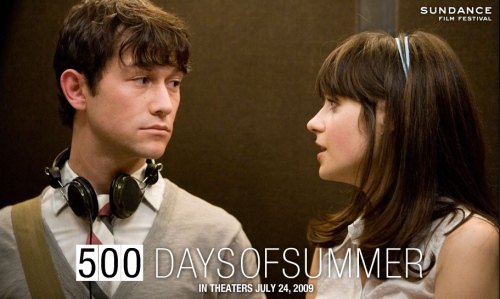
Lisa and I rented this highly rated romantic comedy on iTunes, which was kind of neat. The movie itself we found oddly joyless.
* * * SPOILERS * * *
Like ANNIE HALL, this is a movie about two people who aren't, in the end, made for each other. No spoiler there -- the narrator tells you up front, "This is not a love story."
I like that the story unfolds non-linearly, jumping back and forth between the breakup and the couple getting to know each other, with a cute little gimmick showing how well the hero's life is going -- leaves on a tree for the "summer" of Tom's love for the heroine, whose name is Summer; no leaves for the "winter" of his love for Summer. Always nice when someone can bust up narrative structure and make it work.
And it's interesting to show a relationship that
isn't clicking. Summer tells Tom up front that she doesn't want a committed relationship, and though she seems to enjoy his company a whole lot, she never changes that. He's convinced she's the One, so he ignores her ground rules, hoping she'll fall in love with him, and convincing himself that she is "letting him in," even though that's a long way from "I love you." But it doesn't work.
I wish I had found the execution of the concept more compelling. Tom isn't much of a catch. He's incapable of asking the girl out on a date until she actually kisses him. He acts petulantly when he's not getting the love he wants. He throws tantrums. He makes demands and runs away. I'm not rooting for him to get the girl. I'm rooting him for him to get over himself and grow up. I can't remember any of his lines. There is a cute sequence in an IKEA, but by and large he's so understated that I wasn't rooting for him to get the girl so much as grow a pair. Is that what girls find attractive these days?
Meanwhile, Summer isn't stunningly witty or clever, either. Yes, we all love Zooey Deschanel, but the actress didn't have a lot to work with. She comes across as a girl who's opaque, and so you think there's a hidden mystery to her, but there really isn't. She's just an ordinary girl with a shell around her ordinariness.
So yeah, I'm wondering why people loved the movie so much.
I liked the moment later on in the movie when Tom's sister Chloe busts him on his idealization of the relationship. "If you look back," she tells him, he'll see that she really was never the One. And there's a nice scene where we see how much Summer pulled away from him, doesn't laugh at his joke and won't take his hand, even during what he remembers as the happy part of the relationship.
I would have liked to have seen more done with that. I would have liked to have seen more of that up front -- without focusing on it, just little moments here and there where we're focused on Tom being happy, but in the corner of the screen, dark, out of focus, there's her hand avoiding his. So that, as the movie goes along, we're beginning to see how much Tom is making a relationship up in his head when there isn't one in real life. What does that look like? Summer telling him she's busy that night. Summer flaking out on a date.
That's what intrigued me about the concept: showing how a guy has a different relationship in his head than the one that we can see in front of us. And making more of a meal out of that.
I go back and forth about the two last act story turns. Of
course Tom has an over-the-top meltdown and quits his job. Of course he goes back to his first love, architecture and, in a matter of onscreen minutes, he's interviewing all over the place. You knew that was going to happen by the end of the movie the moment he mentioned to Summer that he useta wanna be an architect but gave it up.
It's a bit weak, because it's just not that easy to get back into architecture when you were a failure five years ago and you've been writing greeting cards since then. And in 2009 when no architecture firm in LA is hiring. What takes the curse off it is that he's never shown succeeding. But we're meant to feel that he will.
And then, there's Summer getting married. It's clever that, just before the end, Tom is turned off of love, but Summer is in love -- they've switched roles. And it's true enough that most of the time a woman says "I'm not looking for a committed relationship," it means "I'm not looking for a committed relationship
with you." A neighbor of ours was in a loosey-goosey relationship for something like 8 years, claiming he never wanted to get married. Then he started seeing his now-wife, and was married inside of a month.
On the other hand we are explicitly told up front that Summer, even before she met Tom, distrusted romance. She hasn't had a lot of relationships. She's wounded by her parents' divorce.
To me it felt like Summer getting married was a betrayal of the character. To me, it turned her from an interesting character to a generic one. From someone defined on her own terms -- an opaque girl who doesn't want to let anyone close -- to someone defined only by her relationship to Tom.
I think it might have been braver to leave Summer loose, available but not really catchable. What if she didn't really push him away? What if she was always willing to see him, and hang with him, and sleep with him, provided only that he never tries to pin her down. That would have made a harder decision for Tom. Yes, you can see Summer, but you'll never have her heart. Is that enough? At some point he'd have to make his own decision to pull away from her.
Instead, Summer makes all his decisions for him. She dumps him. She marries someone else. All he has to do is stop mourning her and get on with his life. That's not a hard decision to make, or shouldn't be.
I think you could have made a much stronger movie about a guy trying to create a relationship with a girl who really is not available for a relationship for anybody. That's what was so heartbreaking about CABARET: Sally Bowles is a wonderful girl to be with, but Brian can't really ever have her.
(500) DAYS OF SUMMER is getting mad ratings on the IMDb, so I'm quite prepared to be told I'm all wrong. And a braver version might not have made
$46 million gross international box office against a 7.5 million production budget. I'm just saying that I didn't fall for the movie. And I feel like I would have, if it had been a little better crafted.
What did you like about the movie? Did you ever really want Tom to get Summer? What did either Tom or Summer have going for them as characters? What were you rooting for to happen? What were you scared might happen?