Monday, July 02, 2012

Ides of March


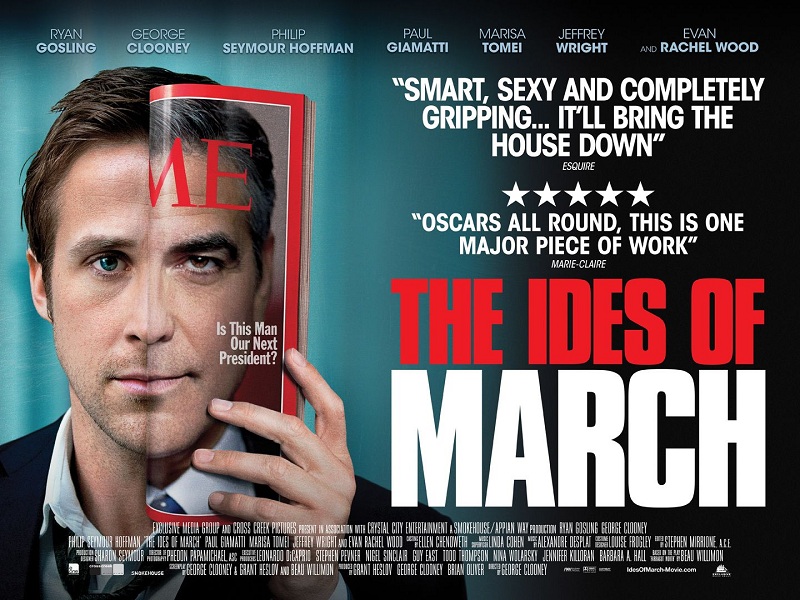
Lisa and I watched THE IDES OF MARCH. We were a bit puzzled. Fromt the trailer, I thought it was the story of a brilliant political operative who discovers that his boss has done something bad and needs to confront him.

/* not actual spoilers but some discussion of the plot */

To us, it seemed like the story of someone who had an almost total lack of political awareness, such as the need for loyalty, or the possibility that people might be willing to do backhanded things to win elections. It seemed like the story of a self-righteous guy who leaves a path of destruction in his wake, while feeling terribly wronged by everyone. To us, it seemed like almost every step he took was a misstep; that a political wunderkind wouldn't do any of those things.

What was odd about it was that we had a feeling we were supposed to root for the guy; that his victory was supposed to be some kind of victory for righteousness. By the end of it, I was rooting for him to get assassinated.

Did anyone see the movie and feel he was a legitimate hero?

Sunday, July 01, 2012

Civ V


Having knocked off a bunch of screenplays I owed, I finally let myself have a bash at Civilization 5. And by "have a bash," of course I mean I disappeared into the game for two 8 hour stretches, barely moving from my desk, to the point where everything kinda hurt. One of them started at 11 pm.

I find the Civ games unbelievably addictive. I have trouble getting away from the game, and when I do, I'm thinking about it. The only way I can stop playing a game once I've started it is either to finish it, or to delete all my saved games off my computer so I have no way to pick it up where I left off. I think I like the decision making. And I like to make things grow. (I also have a garden.)

So every few years they come out with a new version, and I binge, and disappear for a few days. At least this time I was able to stop at the point where it was clear I was going to conquer the world, without having to actually do it, which would have been probably another 8-12 hours.

Happy Canada Day, everyone, and I understand there is some sort of festival going on in Montreal where they play music ... I must get out to that.

Thursday, June 28, 2012

Entry Level PR

Wanna do some part-time on-site PR for a very cool Montreal indie game studio? Web stuff, shooting video, writing, social media? Lemme know.

UPDATE: Based some comments I got, I should explain some things.

This is a PR job. You must be able to spell my name correctly. (Someone did not; at his request I've deleted his comment.) You should be able to find out my email address. (Seriously. It should take less than 60 seconds.)

And then you send me your resume with a personable email explaining why you're the right person for the job. And, because you are SO GOOD, you already figured out which game company and which game. And for serious bonus points, your take on marketing the company. Because you want it that much.

For any job, you want to make sure that you create the best possible first impression. But a PR job, in particular, is about contacting strangers. You need to have a talent, or better, a skill, for contacting strangers. You need to know how to draw people into your story. For a PR job in particular, your self-presentation is the test. Your initial approach should knock my socks off. Otherwise the job will go to someone else who does.

What's Last, Lingers

I was listening to one of Steven Dubner's Freakonomics podcasts, "Bring on the Pain" with Daniel Kahneman, an economist who studied pain vs. the memory of pain in colonoscopies.

Kahneman had people rate the pain of a procedure while they were undergoing it, minute by minute, and then asked them to rate it afterwards. Kahneman discovered two critical factors in how painful people remembered the procedure to be:
  • Peak pain: people remembered the procedure as being as painful as its worst moments; and
  • Final pain: to a lesser extent, people remembered the procedure as being as painful as the last few minutes. Doctors could reduce the memory of pain of the whole procedure simply by slowing down the last few minutes of the procedure to bring the probe out more gently.
I wonder if the same is true about a pitch session.

In theory a pitch is about selling a whole story; and if your pitchee is really on the ball, he or she should be able to gauge the story as a whole. But I think it's true that to a disproportionate extent your pitch will be rated by its peak moments? If you can sell one really amazing scene or spectacle or moment, what's the odds your pitchee will remember your pitch as really amazing? And conversely, if you have a gaping hole in your story, what are the odds she'll remember the hole?

I once heard that Jack Nicholson will do a movie if the script has "two great scenes and no bad ones." ("You want the truth? You can't handle the truth!")

So you better run your pitch up against some civilians to see what they're bumping on, before you go into a pitch meeting. You want to smooth out as many bumps as you can. You also want to make sure you can sell the hell out of at least one moment or scene or spectacle in your story.

Likewise, which will get more traction? A pitch meeting that starts out well but loses steam? Or a pitch that goes out with a bang, in spite of a rocky start? I think the second is more likely to close the sale.

So you should also not be afraid to close the meeting yourself. If you've made your best case, get out! Don't linger. If they're enthusiastic, and they have further questions, well, they'll call you, won't they?

Wednesday, June 27, 2012

Goodies for Newbies

If you are fortunate enough to be a recent grad of one of Canada's top 15 film programs, and have a script that you could shoot for $120,000 to 250,000, Telefilm's new program could give you $120,000. Check it out.

Monday, June 25, 2012

Infamous Players

I've been dipping into Peter Bart's INFAMOUS PLAYERS. It's the story of Peter Bart's tenure at Paramount. He was hired solely on the basis of being a smart New York Times reporter, at a time when all the old rules were being thrown out and no one seemed to know what audience wanted.

Bart, who later headed up Variety, is willing to own up to his mistakes -- fiascos he saw coming and didn't stop, or didn't see coming. He also takes some credit for some major good calls, like pushing LOVE STORY when no one wanted it.

It's a book of war stories. I don't know that anyone actually needs to know what Hollywood was like in the 1970's. But if you're in the biz, you're expected to be able to talk about the old days, even if you weren't there for them. It shows respect to the culture of the industry. It also reminds you that every movie legend has his share of flops and bad calls. And everyone in showbiz experiences ridiculous amounts of frustration over their career.

That last is worth dwelling on. I got a "no" from a funding agency this week, and went around in a blue funk for a day, even though it's been a banner year so far. I had to remind myself how many famous movies started by bouncing around unwanted from studio to studio. A book like this one helps you remember just how much of a mess everyone else's career was, if only you knew it from the inside.

Sunday, June 24, 2012

Spoilers

I watched a bit of Kevin Smith's Hulu series SPOILERS, 'cause I'm in the States (on St. Jean Baptiste!) and I can't watch it in Canada.

The first half of the show is Kevin Smith asking an audience of normal people (the "spoilers") what they thought of a movie. Then he has a guest on. In this one the show was PROMETHEUS. I dunno. Why do I want to watch a handful of random people talk about what they didn't like about a movie? I love the IMDB ratings, because after a couple of thousand people have rated a movie, you can get a pretty good idea of how well it pleased its audience. Between the IMDB and Rottentomatoes, I can get a pretty good idea whether I'm going to like a movie. But this is just a few people.

I think it might be a stronger first half if there were editing -- if Smith asked every member of his audience for their feedback, and then edited in the most insightful answers. But this is uncurated.

The second half is wayyyyyy more interesting. In the episode I watched, Smith had PROMETHEUS's writer Damon Lindelof on the hot seat (an intentionally ridiculously large throne with golden lions). Lindelof has interesting things to say, including the importance of wearing the right t-shirt to your interview with a showrunner, and how he pitched the rewrite on PROMETHEUS.

You can learn a lot from an interview with a guy like Damon Lindelof: how to think about movie stories, sure, but also how to present yourself, how to talk about the guy you're rewriting.

So I recommend the second half of each episode of SPOILERS, if you can get Hulu.

Facebook Ads and Kindle

I got a $50 coupon from Facebook for Facebook Ads, and I put together a little Facebook campaign for my novel THE CIRCLE CAST: THE LOST YEARS OF MORGAN LE FAY. One of the nice things about Facebook Ads is that you can target very specific demographics and groups. So I was able to target girls 13-18 in the US, UK and Canada who are interested in King Arthur, Wicca, historical fantasy, or any of the other books about Morgan le Fay.

A Facebook ad with my book cover did nothing for sales, but then we fooled with the tagline, and went back to my original homemade mockup cover, of a 16-year-old girl looking out at you, and that made a dent. Paperback sales perked up, and Kindle sales increased by a factor of 7.

You can pay Facebook per impression -- the number of times the ad showed up on someone's Facebook page. Or you can pay per click-through. Click-throughs are expensive. Facebook charges on the order of 75 cents for a click-through. However, someone who clicks through is a motivated consumer. They are intrigued by your ad and they want to know more.

And if you have a Kindle book, they can have the book right now.

It's interesting that I can see all these metrics from my desktop. I know every time someone clicks on my ad. And I know every time someone buys my book on Amazon.

(I'm assuming that's 99% of the business the ad is doing. Theoretically I imagine someone could see the ad, click through to the Amazon page, and then go buy a paper copy in a store. I guess people still sometimes do that.)

This gets me to thinking about how people are concerned that Facebook knows all about them. There are also advantages to Facebook knowing all about you. If Facebook can tell you about books that you would probably like, that's a win, isn't it? I'm a consumer. I like to buy good stuff. I just don't want to hear about stuff I don't care about. If I can get more ads about stuff that I might actually like or need, and get fewer solicitations for Viagra, that's a win for me.

(And anyway, I don't put anything on Facebook that would truly embarrass me if it got out. I gave up a long time ago on running for President.)