David W. Zucker is the showrunner of CBS's drama THE GOOD WIFE. He talked about the genesis of the show at the Banff Worldwide Television Festival this June.
The show was actually created by Michelle and Robert King. “What they came in with was the notion of the disgraced relationship. and you could see the opportunities to go five years with the show. She’s a compelling character, and every decision she makes has a huge impact on those around her, and she gets involved in the moral and ethical gray zones that corrupted her husband.”
What attracted CBS was the idea that Julianna Margulies’s character was also going to be a lawyer. CBS “has got fat and healthy knowing how to develop and promote franchise shows, and this gave them the potential of close ended case stories.
“But they passed on the first pitch. You could tell from their questions what had freaked them out. In the original pitch there was more time with the lead-up before she goes back to being a lawyer” [as she was 13 years before]. “The Kings wanted to explore the whole media frenzy. But the studio didn’t want to live there, because that’s not where a procedural would live. They didn’t want to spend a lot of time on the premise.
“So we went back to the same exec, and they were very open. I said, I think we can address your problems. Because it wasn’t a problem with the characters.”
So they made it more procedural (I’ve been in the same boat. I have a pay cable series that I developed; now we’re taking it to American networks. It has a fairly unique main character that everyone’s interested in. But in the serial pay cable version, she was working at a church charity; that took her into her stories. In the version we’ll pitch CBS, she’s a cop, and she solves crimes. If a network wants olive bread, you’re foolish to give them pumpernickel.)
The network liked the new version quite a bit more. “But [CBS president] Nina [Tassler]’s notes were very broad. And I tried to figure out what was missing in the script for her. Normally CBS are logic police if there is any possible confusion for the audience. But the interesting thing was that Nina was missing a deeper connection to the Alicia character. The studio and the network had been pushing for more of a procedural. Now the head of the network was asking for the thing they’d wanted us to do less of. They weren’t asking for any revisions but it left us feeling off.
“So we came back and said, “We want to go deeper with Alicia.” And out of that we got the scene in the pilot that Alicia has with her mother in law in the kitchen. That was the only time we get an expression from her what Peter put her through. And she loses it. And that single scene provided another texture. It also did a beautiful thing for us – made Nina feel she had ownership of the script.”
One of the weird things about Hollywood is that it’s not like what you think, but everything they tell you is also true. We joke about how you don’t want to be the guy at the gym who’s inflicting his script on all the producers, but passing along his script at the gym is exactly why Ian Brennan has gone from theater actor to creator of a hit show. And there are as many paths to getting your show on the air as there are shows. You can get your show on the air if you’re not an experienced TV writer — the Kings were experienced, but if you look at their credits, they’re almost all lower budget features. But they took it to Ridley and Tony Scott’s company and, though they’re “second chair” to David W. Zucker, they’re integral to the show.
The thing that all these shows we’ve been hearing about have in common is great characters — usually one great character — in a compelling and fresh situation. If you have that, a bit of luck and a lot of persistence will take you the rest of the way.
Showing posts with label Banff. Show all posts
Showing posts with label Banff. Show all posts
Sunday, July 04, 2010

Saturday, July 03, 2010
Bill Prady at Banff, Part Two
“We write every episode together from page one. There are seven of us on staff, and generally we are all sitting around while our assistant sits at a computer and typies it all up.
“To keep our momentum, we tend to skip over the science and put it in later: “Science to come.” The science itself isn’t crucial to understanding the show. It’s like Ricky shouting at Lucy in Spanish. You don’t have to understand it, but if you do, there’s another level available to you.
“We have a science advisor. A friend of a friend of mine was an astrophysicist at UCLA. What we did with the pilot was find stuff and then he corrected it. So for the show we asked him for recommendations for a science advisor. But he said, “can I do it?”
“Then later he told me he was on a plane reading a script, women came over and started talking to him. Welcome to LA where scripts are magic.
“The science has to be right. There was a show that shall remain nameless, but one of the characters was a paleontologist. And the paleontology was never anything that sounded right.
“We always have ‘the nerd beat.’ This is usually whatever we were talking about ten minutes before. Like Green Lantern is vulnerable to wood. But classic Green Lantern is vulnerable to the color yellow. Which means you can take both green lanterns out with a #2 pencil.
“Here’s our test for humor. If you can say a line to a friend, and your friend gets the joke without any context, then it’s a bad joke. You should have to spend ten minutes explaining who the characters are. If your friend doesn’t get the joke unless he knows the whole setup, then it’s a good joke.”
“To keep our momentum, we tend to skip over the science and put it in later: “Science to come.” The science itself isn’t crucial to understanding the show. It’s like Ricky shouting at Lucy in Spanish. You don’t have to understand it, but if you do, there’s another level available to you.
“We have a science advisor. A friend of a friend of mine was an astrophysicist at UCLA. What we did with the pilot was find stuff and then he corrected it. So for the show we asked him for recommendations for a science advisor. But he said, “can I do it?”
“Then later he told me he was on a plane reading a script, women came over and started talking to him. Welcome to LA where scripts are magic.
“The science has to be right. There was a show that shall remain nameless, but one of the characters was a paleontologist. And the paleontology was never anything that sounded right.
“We always have ‘the nerd beat.’ This is usually whatever we were talking about ten minutes before. Like Green Lantern is vulnerable to wood. But classic Green Lantern is vulnerable to the color yellow. Which means you can take both green lanterns out with a #2 pencil.
“Here’s our test for humor. If you can say a line to a friend, and your friend gets the joke without any context, then it’s a bad joke. You should have to spend ten minutes explaining who the characters are. If your friend doesn’t get the joke unless he knows the whole setup, then it’s a good joke.”
Friday, July 02, 2010
Bill Prady at Banff, Part One
Bill Prady showruns the incredibly highly rated comedy series BIG BANG THEORY. He had some interesting things to say about the genesis of the show at the Banff Worldwide Television Festival.
The show originated out of misery: Prady was unhappy. “Marta Kaufman [FRIENDS] had been blackmailed by the WB into running a 1 hour drama about four sisters called RELATED. I was her third choice for the number two writer. She wasn’t happy. It was awful. We were working a mile north of the WB lot. I started walking south down Hollywood Way, and I wound up in the office of Chuck Lorre.
“Now Chuck has no need for any more money. He’s created TWO AND A HALF MEN. I’ve told him, ‘Has no one explained to you how wealthy you are?’ But he’s passionate about his work.
“We decided to work on a pilot together. We wouldn’t pitch the show, we would just figure it out ourselves. We went through a bunch of ideas. Chuck had read a science fiction novel, and we tried that for a month adapting it until we realized it wasn’t a good idea.
“There was an actress famous for indie films who wanted to do TV. We developed a show for her about a woman who’s tough on the outside but out on her own for the first time. That didn’t work.
“Then we thought, let’s put these two charcters together. The original version of the show was about Leonard and Sheldon and this very tough version of Penny.
“So we wrote the first two scenes, and brought in a couple of actors and had them perform it for the president of CBS, and they commissioned the pilot.”
(Okay, let’s just stop there a moment. Remember how Ian Brennan was a theater actor before his gym buddy took his spec feature of GLEE to Ryan Murphy? Remember how Vince Gilligan created BREAKING BAD because he had no idea how to feed his family? Stories that give you hope that your long dry spell could just be the prelude to earthshattering success? Okay, this is the opposite. Somehow I suspect that if you were buds with Chuck Lorre, and he developed a show with you, and took it to the president of CBS, you could probably get a pilot commitment, too.)
“The original female character was envisioned as tough as nails but with a sweet inside, and it would take a while to break her down. Now I’m not a big fan of focus group testing, but the company that focus grouped BIG BANG had never seen such a gap between a score for a show and a score for a character. They loved the show. They hated Penny.
“Supposedly you never watch the men in a focus group. They’re dull, they don’t say much. Watch the women’s conversation. And all they were talking about was how they could get rid of this woman on the show and keep the guys.
“Generally the decisions on pilot pickups are made on Mother’s Day. This is to ensure that you have an absolutely miserable Mother’s Day. The first half you can’t focus on anything because you’re waiting to hear. And then you hear you didn’t get picked up.
“In this case, though, the network did an almost unheard of thing. They said, ‘we don’t want the show but we’ll do another pilot because we like the guys.’
“They thought it was a casting issue. But we thought it was a writing issue – no actress could play the part we’d written sympathetically.
So we brought in Kaley Cuoco. She’d actually auditioned before, but she was all wrong for the tough version, and it turned out she was perfect for the nice one.”
The show originated out of misery: Prady was unhappy. “Marta Kaufman [FRIENDS] had been blackmailed by the WB into running a 1 hour drama about four sisters called RELATED. I was her third choice for the number two writer. She wasn’t happy. It was awful. We were working a mile north of the WB lot. I started walking south down Hollywood Way, and I wound up in the office of Chuck Lorre.
“Now Chuck has no need for any more money. He’s created TWO AND A HALF MEN. I’ve told him, ‘Has no one explained to you how wealthy you are?’ But he’s passionate about his work.
“We decided to work on a pilot together. We wouldn’t pitch the show, we would just figure it out ourselves. We went through a bunch of ideas. Chuck had read a science fiction novel, and we tried that for a month adapting it until we realized it wasn’t a good idea.
“There was an actress famous for indie films who wanted to do TV. We developed a show for her about a woman who’s tough on the outside but out on her own for the first time. That didn’t work.
“Then we thought, let’s put these two charcters together. The original version of the show was about Leonard and Sheldon and this very tough version of Penny.
“So we wrote the first two scenes, and brought in a couple of actors and had them perform it for the president of CBS, and they commissioned the pilot.”
(Okay, let’s just stop there a moment. Remember how Ian Brennan was a theater actor before his gym buddy took his spec feature of GLEE to Ryan Murphy? Remember how Vince Gilligan created BREAKING BAD because he had no idea how to feed his family? Stories that give you hope that your long dry spell could just be the prelude to earthshattering success? Okay, this is the opposite. Somehow I suspect that if you were buds with Chuck Lorre, and he developed a show with you, and took it to the president of CBS, you could probably get a pilot commitment, too.)
“The original female character was envisioned as tough as nails but with a sweet inside, and it would take a while to break her down. Now I’m not a big fan of focus group testing, but the company that focus grouped BIG BANG had never seen such a gap between a score for a show and a score for a character. They loved the show. They hated Penny.
“Supposedly you never watch the men in a focus group. They’re dull, they don’t say much. Watch the women’s conversation. And all they were talking about was how they could get rid of this woman on the show and keep the guys.
“Generally the decisions on pilot pickups are made on Mother’s Day. This is to ensure that you have an absolutely miserable Mother’s Day. The first half you can’t focus on anything because you’re waiting to hear. And then you hear you didn’t get picked up.
“In this case, though, the network did an almost unheard of thing. They said, ‘we don’t want the show but we’ll do another pilot because we like the guys.’
“They thought it was a casting issue. But we thought it was a writing issue – no actress could play the part we’d written sympathetically.
So we brought in Kaley Cuoco. She’d actually auditioned before, but she was all wrong for the tough version, and it turned out she was perfect for the nice one.”
Thursday, July 01, 2010
Ricky Gervais at Banff
I didn’t make a lot of notes at Ricky Gervais’s talk at Banff. Gervais is a very funny man to listen to, but he wasn’t talking much about craft. I did learn that his name is pronounced "Gervaise. I had a great time at William Shatner’s panel moderated by Bill Prady too, but I can’t say I learned much beyond the importance of doing Shakespeare.
Towards the end of his talk, though, he mentioned having a list of do’s and don’t’s for THE OFFICE. He mentioned some of them:
“No exposition. ‘You know your brother who just came back from the Yucatan.’ ‘Yeah... he’s my brother, of course I know him.’
"No people entering just to do the important thing.
"No Eye of God camera coming between two people dancing. I mean, whose point of view is that?
"No director’s jokes. Nothing the character wouldn’t say just because it’s funny. We cut out half the jokes that were too smartass for the character. For example, Tim and Dawn weren’t supposed to be having a good time if they’re not together. Tim was supposed to be Norm from Cheers. But he was too smart. And the audience would think, if he’s that smart and happy, I don’t care. So what we did was no one laughs at his jokes. Only Dawn laughs at his jokes. That meant more than getting the laugh.
"Also, jokes sometimes ended with an embarrassing silence. That excited us as well.
"The reality of the piece excited us. The realer it was, the more it would resonate.
"It was about a man in free fall, who confused respect with popularity.
"Oh, and we knew we had to keep reminding people it was a fake documentary. Otherwise all we had was a slow sitcom without enough jokes.”
Towards the end of his talk, though, he mentioned having a list of do’s and don’t’s for THE OFFICE. He mentioned some of them:
“No exposition. ‘You know your brother who just came back from the Yucatan.’ ‘Yeah... he’s my brother, of course I know him.’
"No people entering just to do the important thing.
"No Eye of God camera coming between two people dancing. I mean, whose point of view is that?
"No director’s jokes. Nothing the character wouldn’t say just because it’s funny. We cut out half the jokes that were too smartass for the character. For example, Tim and Dawn weren’t supposed to be having a good time if they’re not together. Tim was supposed to be Norm from Cheers. But he was too smart. And the audience would think, if he’s that smart and happy, I don’t care. So what we did was no one laughs at his jokes. Only Dawn laughs at his jokes. That meant more than getting the laugh.
"Also, jokes sometimes ended with an embarrassing silence. That excited us as well.
"The reality of the piece excited us. The realer it was, the more it would resonate.
"It was about a man in free fall, who confused respect with popularity.
"Oh, and we knew we had to keep reminding people it was a fake documentary. Otherwise all we had was a slow sitcom without enough jokes.”
Wednesday, June 30, 2010
Vince Gilligan at Banff, Part Three
Q. How much did you have with the pilot script? How detailed a series arc did you have?
A. Great question. It really depends on the kind of people you’re selling to. With the people I was pitching, I didn’t have to give them anything but the pilot.
A lot of people did say, this is a great pilot, but I don’t get where it goes after the first episode. I told them, it's Mr. Chips turns into Scarface. I've said that 100 times.
But I'd give a few highlight moments. Most of them in fact never happened. Like, Jesse Pinkman dies. I always assumed he'd die in a big season ender at the end of Season One, in a drug deal instigated by Walt. That would be a terrible burden of guilt for Walt to carry, and guilt and rage are great fuel for further drama.
But I so enjoyed working with Aaron Paul from the pilot onwards… it must have been very early, I realized, there's no way in hell I’m going to kill this guy off. By episode 2 or 3 I sat him down and told him, "Hey, by the way, I was going to kill you off." And he really freaked out. I said, "No, this is a compliment to you that I’m not going to kill you off."
For a long time after that, every time Bryan Cranston (playing Walter White) would get the script first, he'd tell Aaron, "Ohhh, buddy, it was nice working with you!"
Anyway, when I was pitching, I’d pitch these crazy moments -- what Stanley Kubrick calls non-submergible moments, moments that don't submerge into memory -- that we have never done in 3 years on the show. But for Sony/AMC I didn’t need those.
Still, it’s good to be as prepared as you can, even if it’s only a sales too that you’ll never use later. Once they’re pregnant, they’re pregnant.
I don’t know how you figure out something 100 hours in advance. It has to be a free flowing story telling process. There are so many realities that you can’t foresee. Like, Jesse Pinkman's house was sold out from under us. The owners of the house sold it. So we needed new plot elements to explain why he’s no longer in the house. So we had his mom and dad find the meth lab in his basement, and his name isn't on the lease.
The important thing is to believe in it. If you're selling something you don't believe in, that if you're successful you're going to have to live with for years … there's easier ways of making money.
A. Great question. It really depends on the kind of people you’re selling to. With the people I was pitching, I didn’t have to give them anything but the pilot.
A lot of people did say, this is a great pilot, but I don’t get where it goes after the first episode. I told them, it's Mr. Chips turns into Scarface. I've said that 100 times.
But I'd give a few highlight moments. Most of them in fact never happened. Like, Jesse Pinkman dies. I always assumed he'd die in a big season ender at the end of Season One, in a drug deal instigated by Walt. That would be a terrible burden of guilt for Walt to carry, and guilt and rage are great fuel for further drama.
But I so enjoyed working with Aaron Paul from the pilot onwards… it must have been very early, I realized, there's no way in hell I’m going to kill this guy off. By episode 2 or 3 I sat him down and told him, "Hey, by the way, I was going to kill you off." And he really freaked out. I said, "No, this is a compliment to you that I’m not going to kill you off."
For a long time after that, every time Bryan Cranston (playing Walter White) would get the script first, he'd tell Aaron, "Ohhh, buddy, it was nice working with you!"
Anyway, when I was pitching, I’d pitch these crazy moments -- what Stanley Kubrick calls non-submergible moments, moments that don't submerge into memory -- that we have never done in 3 years on the show. But for Sony/AMC I didn’t need those.
Still, it’s good to be as prepared as you can, even if it’s only a sales too that you’ll never use later. Once they’re pregnant, they’re pregnant.
I don’t know how you figure out something 100 hours in advance. It has to be a free flowing story telling process. There are so many realities that you can’t foresee. Like, Jesse Pinkman's house was sold out from under us. The owners of the house sold it. So we needed new plot elements to explain why he’s no longer in the house. So we had his mom and dad find the meth lab in his basement, and his name isn't on the lease.
The important thing is to believe in it. If you're selling something you don't believe in, that if you're successful you're going to have to live with for years … there's easier ways of making money.
Tuesday, June 29, 2010
Vince Gilligan at Banff, Part Two
Q. Is Walter White a good guy who’s made horrible decisions? Or is he a bad guy who’s finally fulfilling himself?
A. I don’t know. The franchise of this show is transformation. We are transforming our main character -- we’re turning Mr Chips into Scarface. I don’t know for sure if this is a dark world corrupting an innocent man, or all this stuff is within him and it’s now coming out. A man who previously lived so bottled up due to fear is now free of fear. Without the cancer diagnosis he would have lived a life of quiet desperation."
Q: What do you find admirable about him?
Gilligan: There’s not a lot. I love Walt. He loves his family. He never gives up. He’s dogged. He has a passion for something in life. Has a passion for chemistry. People who have passion are interesting. But he is not the character I like the best on the show, although he is endlessly interesting to write about. Jesse is kind of the moral center of the show -- at least he is the moral center of his and White's little thing that they've got going. He's the voice of reason. 'How much money do we need?' He's trying to live up to being the bad guy, but he can’t really be the bad guy.
Q. Do you know how the series will end?
A. I’m impressed that Damon Lindelof knew the ending of LOST after the end of Season One. As to where BREAKING BAD ends … I have hopes and dreams for the characters...
Q. Do you see going two more years?
A. I like setting an end date. When the LOST guys went to ABC they had a huge hit show and they said to their bosses: let’s put a clock on this thing. My hat is off to them. Every serialized show should think about doing that.
But the business doesn’t do that. I would love to put a clock on BREAKING BAD. Does that mean the end of Season 4? Season 5? I can’t imagine anything past season 5. I love a countdown – you’re working towards a very concrete definitive end. It allows you to come up to a more satisfying ending. And I always had a continuum: he goes from Mr. Chips to Scarface. Well, he’s got pretty bad. How more bad can he get? There’s no finite limts on his continuum.
But you want to keep working. And thinking as a showrunner, my show employs 150-200 people, and I want to keep them working.
But you want to leave the party a little too early and have people miss you. It’s tough. It’s the thing I ask myself all the thing.
Q. And of course internationally it makes a lot of money.
A. Our show is a tough sell. I’m amazed it’s on the air. It’s like a bumblebee. Scientists it’s supposed to be impossible for it to fly. There’s no reason why this should work. But it does.
A. I don’t know. The franchise of this show is transformation. We are transforming our main character -- we’re turning Mr Chips into Scarface. I don’t know for sure if this is a dark world corrupting an innocent man, or all this stuff is within him and it’s now coming out. A man who previously lived so bottled up due to fear is now free of fear. Without the cancer diagnosis he would have lived a life of quiet desperation."
Q: What do you find admirable about him?
Gilligan: There’s not a lot. I love Walt. He loves his family. He never gives up. He’s dogged. He has a passion for something in life. Has a passion for chemistry. People who have passion are interesting. But he is not the character I like the best on the show, although he is endlessly interesting to write about. Jesse is kind of the moral center of the show -- at least he is the moral center of his and White's little thing that they've got going. He's the voice of reason. 'How much money do we need?' He's trying to live up to being the bad guy, but he can’t really be the bad guy.
Q. Do you know how the series will end?
A. I’m impressed that Damon Lindelof knew the ending of LOST after the end of Season One. As to where BREAKING BAD ends … I have hopes and dreams for the characters...
Q. Do you see going two more years?
A. I like setting an end date. When the LOST guys went to ABC they had a huge hit show and they said to their bosses: let’s put a clock on this thing. My hat is off to them. Every serialized show should think about doing that.
But the business doesn’t do that. I would love to put a clock on BREAKING BAD. Does that mean the end of Season 4? Season 5? I can’t imagine anything past season 5. I love a countdown – you’re working towards a very concrete definitive end. It allows you to come up to a more satisfying ending. And I always had a continuum: he goes from Mr. Chips to Scarface. Well, he’s got pretty bad. How more bad can he get? There’s no finite limts on his continuum.
But you want to keep working. And thinking as a showrunner, my show employs 150-200 people, and I want to keep them working.
But you want to leave the party a little too early and have people miss you. It’s tough. It’s the thing I ask myself all the thing.
Q. And of course internationally it makes a lot of money.
A. Our show is a tough sell. I’m amazed it’s on the air. It’s like a bumblebee. Scientists it’s supposed to be impossible for it to fly. There’s no reason why this should work. But it does.
Monday, June 28, 2010
Vince Gilligan at Banff, Part One
Vince Gilligan is the creator and showrunner of BREAKING BAD, which AMC has just renewed for a fourth seasons. I attended his master class at the Banff Worldwide Television Festival. Here are my notes from the session.
Gilligan “hadn’t had a paying gig in a while" even though he'd worked on the hit long-running show THE X-FILES. He and a friend in a similar predicament were on the phone discussing what they could possibly do to feed their families, and (if my notes are right), his friend talked about "buying an old RV and building a crystal meth lab. So during this phone conversation this character named Walter White came into my head, which is very unusual for something to hit me like that.
[The question nobody asked in the session was: whatever happened to the friend? Normally if you're in a phone conversation with a fellow writer trying to figure out shows to write, and one of you gets an idea, both of you should work on the idea, since it came out of "the room." On the other hand if they were just shooting the breeze about being out of work, Gilligan was free and clear to write up his idea on his own.]
"The first question when you get an idea is of course: is it a movie or a tv show? Is it two hours or 100 hours of story? I don't know if we can get to a hundred, but…"
Gilligan had a "pre-existing relationship with Sony TV. I had a blind TV commitment -- I'd done an ill-fated CBS pilot for them. They read BREAKING BAD and kind of looked at me oddly, 'what the hell is this?' But they bought it"
(I thought it was interesting and rather inspiring that of five master-classes, two were from writers who were wondering where their next paycheck was coming from immediately prior to setting up their hit show.)
"Once the studio bought the idea, they were my partners. We went around town to different networks. I knew what AMC was, but AMC never entered the equation. We thought there were three possibilities: HBO, Showtime, and FX. We approached all three. FX was interested for a while and then passed. So I tried to turn this into a movie."
(Lisa and I have done this a number of times. I have a movie under option that I'm attached to direct that started out as a TV pitch I couldn't set up; and we just got a grant to write another movie that started out as a TV pitch. A TV series and a movie are very different animals, but when you have a great character and a compelling situation, why waste it?"
"My wonderful agent Mark Gordon was at the time assistant to my other agent, and unbeknownst to me, he sent the pilot script to AMC, which he knew at that point was interested in making the jump into scripted programming and was about to open MAD MEN. So I got a call: 'AMC is very interested in your pilot script, would you like to meet with them?'"
"I'm eternally grateful that nobody asked me to make the characters more likable. You go to a lot of these meetings where people have read the material and you get glad handed to death and then the death by 1000 cuts begins. 'Does he have to be a meth dealer? Does he have to be 50 years old? Our research shows that 50 year olds are not interesting to our audience.' You have to be willing to walk the heck out the door. But Sony and AMC were courageous. And AMC had the courage of their ignorance because they’d never done scripted TV before."
"They only called once, when we had Walter White give Jesse's girlfriend extra heroin so she'd OD. They called, “are you sure you want to go that dark? Let's talk about this.”
"Now, executive notes are not always wrong. And when people tell you you're drunk, maybe you'd better sit down. If something scares you and excites you at the same time you really want to examine it from all angles. You want to hear what people have to say. Not polling them. But it was such a scary thing we felt a need to do a gut check with a bunch of people and see if we’re going too far too fast. So we thought about it, and we decided to let Walter just watch Jesse’s girlfriend choke to death on her own vomit."
(Oh, and here is BREAKING BAD NOW ON ABC!!!)
Gilligan “hadn’t had a paying gig in a while" even though he'd worked on the hit long-running show THE X-FILES. He and a friend in a similar predicament were on the phone discussing what they could possibly do to feed their families, and (if my notes are right), his friend talked about "buying an old RV and building a crystal meth lab. So during this phone conversation this character named Walter White came into my head, which is very unusual for something to hit me like that.
[The question nobody asked in the session was: whatever happened to the friend? Normally if you're in a phone conversation with a fellow writer trying to figure out shows to write, and one of you gets an idea, both of you should work on the idea, since it came out of "the room." On the other hand if they were just shooting the breeze about being out of work, Gilligan was free and clear to write up his idea on his own.]
"The first question when you get an idea is of course: is it a movie or a tv show? Is it two hours or 100 hours of story? I don't know if we can get to a hundred, but…"
Gilligan had a "pre-existing relationship with Sony TV. I had a blind TV commitment -- I'd done an ill-fated CBS pilot for them. They read BREAKING BAD and kind of looked at me oddly, 'what the hell is this?' But they bought it"
(I thought it was interesting and rather inspiring that of five master-classes, two were from writers who were wondering where their next paycheck was coming from immediately prior to setting up their hit show.)
"Once the studio bought the idea, they were my partners. We went around town to different networks. I knew what AMC was, but AMC never entered the equation. We thought there were three possibilities: HBO, Showtime, and FX. We approached all three. FX was interested for a while and then passed. So I tried to turn this into a movie."
(Lisa and I have done this a number of times. I have a movie under option that I'm attached to direct that started out as a TV pitch I couldn't set up; and we just got a grant to write another movie that started out as a TV pitch. A TV series and a movie are very different animals, but when you have a great character and a compelling situation, why waste it?"
"My wonderful agent Mark Gordon was at the time assistant to my other agent, and unbeknownst to me, he sent the pilot script to AMC, which he knew at that point was interested in making the jump into scripted programming and was about to open MAD MEN. So I got a call: 'AMC is very interested in your pilot script, would you like to meet with them?'"
"I'm eternally grateful that nobody asked me to make the characters more likable. You go to a lot of these meetings where people have read the material and you get glad handed to death and then the death by 1000 cuts begins. 'Does he have to be a meth dealer? Does he have to be 50 years old? Our research shows that 50 year olds are not interesting to our audience.' You have to be willing to walk the heck out the door. But Sony and AMC were courageous. And AMC had the courage of their ignorance because they’d never done scripted TV before."
"They only called once, when we had Walter White give Jesse's girlfriend extra heroin so she'd OD. They called, “are you sure you want to go that dark? Let's talk about this.”
"Now, executive notes are not always wrong. And when people tell you you're drunk, maybe you'd better sit down. If something scares you and excites you at the same time you really want to examine it from all angles. You want to hear what people have to say. Not polling them. But it was such a scary thing we felt a need to do a gut check with a bunch of people and see if we’re going too far too fast. So we thought about it, and we decided to let Walter just watch Jesse’s girlfriend choke to death on her own vomit."
(Oh, and here is BREAKING BAD NOW ON ABC!!!)
Breaking Bad is now on ABC - watch more funny videos
Sunday, June 27, 2010
Ian Brennan at Banff, Part Two
GLEE is a rare bird among writing rooms. It’s just Brennan and Ryan and Brad. “We don’t have a writing staff, which is not typical. I know on OVER THERE it was Bochco and one other guy. But I don’t understand how you do it differently. We co-write everything. We’re credited sort of randomly on the show. But we all do passes. Ryan has a really good sense of what plays in Peoria. If I wrote it, one million people would really f***ing love it.” [Note to Canadian readers: that’s a very small number of viewers.]
“Now that we’re picked up for season three, hiring writing staff would probably actually slow us down. There would be almost a learning curve – how would someone come in to write for us? Anyway, writing the show is getting easier. The show tells you what it wants. And now that people like it, you don’t think ‘I’m writing a turd.’”
One of the audience members asked if the characters were going to write original music, but Brennan didn’t think so. “The secret to how our show works is two things for me. First, people singing for no reason. I don’t, ironically, like musicals. Unless I’m in them. My sister and I when we were very young were watching THE SOUND OF MUSIC, and we were, like, ‘how do they know all the words?’ With our show, it makes more sense that people are singing. And it’s music you know, so there’s an endorphin rush from the moment you know what song it is, you’re already going there. I mean, now we can stretch the boundaries a bit, but don’t just have people just burst into song.”
A reporter asked about a NEWSWEEK article about whether gay actors can play straight people. “I don’t feel I have that much to contribute. I guess we are still obsessed with where people put their genitals
We still all giggle at that. The generation behind us is officially not going to care. They already kind of don’t care. You’re going to have to apologize to your children or grandchildren, ‘Yeah, it used to be bad, gay people couldn’t marry and all this stuff.’ I mean, are we really talking about this?”
“The tour beat all expectations. We just wondered, could we do a live tour? Would it be good? We threw out a trial balloon — and all the venues sold out in 30 seconds or something insane.”
“We get calls all the time from people who want to be on our show, but you don’t want it to be THE LOVE BOAT. I mean, ‘Who would you be?’”
“I keep hearing that there are budget cuts in high schools everywhere, but because of the show, now they don’t dare cut Glee Club. So the show is a snake eating its own tail. But I hope it isn’t reserved for music. I wouldn’t be here if not for the theater department. I’m 100% a product of American public school system; this is the logical endpoint of my arts education. Public education works – it did for me. Don’t cut all that arts stuff. If not for that, I’d be a veterinarian in Chicago.”
“I can only make sense of the world through making fun of things. For me the show is always funny, but the humor has to cut against something. A grounded foundation of story and character and heart. Oddly enough we kind of learned early on that the episodes that read the funniest on the page aren’t that funny. It’s the sad episodes, the ones that key into that sanguine earnest soft feeling that you had when you first fell in love... those are the ones that really make you laugh.”
“Now that we’re picked up for season three, hiring writing staff would probably actually slow us down. There would be almost a learning curve – how would someone come in to write for us? Anyway, writing the show is getting easier. The show tells you what it wants. And now that people like it, you don’t think ‘I’m writing a turd.’”
One of the audience members asked if the characters were going to write original music, but Brennan didn’t think so. “The secret to how our show works is two things for me. First, people singing for no reason. I don’t, ironically, like musicals. Unless I’m in them. My sister and I when we were very young were watching THE SOUND OF MUSIC, and we were, like, ‘how do they know all the words?’ With our show, it makes more sense that people are singing. And it’s music you know, so there’s an endorphin rush from the moment you know what song it is, you’re already going there. I mean, now we can stretch the boundaries a bit, but don’t just have people just burst into song.”
A reporter asked about a NEWSWEEK article about whether gay actors can play straight people. “I don’t feel I have that much to contribute. I guess we are still obsessed with where people put their genitals
We still all giggle at that. The generation behind us is officially not going to care. They already kind of don’t care. You’re going to have to apologize to your children or grandchildren, ‘Yeah, it used to be bad, gay people couldn’t marry and all this stuff.’ I mean, are we really talking about this?”
“The tour beat all expectations. We just wondered, could we do a live tour? Would it be good? We threw out a trial balloon — and all the venues sold out in 30 seconds or something insane.”
“We get calls all the time from people who want to be on our show, but you don’t want it to be THE LOVE BOAT. I mean, ‘Who would you be?’”
“I keep hearing that there are budget cuts in high schools everywhere, but because of the show, now they don’t dare cut Glee Club. So the show is a snake eating its own tail. But I hope it isn’t reserved for music. I wouldn’t be here if not for the theater department. I’m 100% a product of American public school system; this is the logical endpoint of my arts education. Public education works – it did for me. Don’t cut all that arts stuff. If not for that, I’d be a veterinarian in Chicago.”
“I can only make sense of the world through making fun of things. For me the show is always funny, but the humor has to cut against something. A grounded foundation of story and character and heart. Oddly enough we kind of learned early on that the episodes that read the funniest on the page aren’t that funny. It’s the sad episodes, the ones that key into that sanguine earnest soft feeling that you had when you first fell in love... those are the ones that really make you laugh.”
Saturday, June 26, 2010
Ian Brennan at Banff, Part One
Ian Brennan has had one of the most shocking and hope-inspiring trajectories I have ever heard of. Today, he’s one of the creators of the massive hit show GLEE. But if you’d talked to him two or three years ago, he wouldn’t even have told you he was a writer. “Writing had been my hobby. I was an actor.” A theater actor. He had been trying to write important plays. “But once you stop trying to write something ‘important,’ it frees you up to write what you really love.”
Then he wrote the script to GLEE, based on his fairly miserable experience as member of the Prospect High School show choir in Mount Prospect, Illinois. The draft he wrote wasn’t the peppy, arch, fluffy show that’s provoked a nationwide road show. It was a darker story, “more like JUNO or ELECTION.”
Fortunately, Mike Novick, a guy he knew at his gym, knew Ryan Murphy, one of the guys who’d created NIP/TUCK. (This is why you want to live in LA.) NIP/TUCK was just winding up its last season. Murphy was looking for a new show to do.
Murphy and his partner Brad Falchuck loved the script. Murphy had been in a glee club, too. More accurately, they loved their take on Brennan’s script. So they called him in and pitched him their version of the show. It was a TV series, and it was much lighter.
“So I sat down and wrote the first draft of the pilot.”
The pilot was picked up amazingly fast. The only note from Fox was “I think you need a nemesis inside the school. I can’t believe we missed that. And Ryan just sat back and said, ‘Yeah, I think it’s a cheerleader named Sue Sylvester.’ And now I get to write her.”
“So we were like the dog that actually catches a car: what do I do now?”
“Not that I wasn’t working hard as an actor for 12 years in the theater, but then for this to randomly happen. It’s like you’re panning for gold and — hey, remember that lottery ticket you bought?”
In other words, campers: this is one of those crazy true stories that make people move to Hollyweird and hope they'll luck into a hit show of their own. because if you have something great, and you write from your heart, and people like you, and you hit some incredible luckand sacrifice a virgin to Joss Whedon, it can actually happen.
Then he wrote the script to GLEE, based on his fairly miserable experience as member of the Prospect High School show choir in Mount Prospect, Illinois. The draft he wrote wasn’t the peppy, arch, fluffy show that’s provoked a nationwide road show. It was a darker story, “more like JUNO or ELECTION.”
Fortunately, Mike Novick, a guy he knew at his gym, knew Ryan Murphy, one of the guys who’d created NIP/TUCK. (This is why you want to live in LA.) NIP/TUCK was just winding up its last season. Murphy was looking for a new show to do.
Murphy and his partner Brad Falchuck loved the script. Murphy had been in a glee club, too. More accurately, they loved their take on Brennan’s script. So they called him in and pitched him their version of the show. It was a TV series, and it was much lighter.
“So I sat down and wrote the first draft of the pilot.”
The pilot was picked up amazingly fast. The only note from Fox was “I think you need a nemesis inside the school. I can’t believe we missed that. And Ryan just sat back and said, ‘Yeah, I think it’s a cheerleader named Sue Sylvester.’ And now I get to write her.”
“So we were like the dog that actually catches a car: what do I do now?”
“Not that I wasn’t working hard as an actor for 12 years in the theater, but then for this to randomly happen. It’s like you’re panning for gold and — hey, remember that lottery ticket you bought?”
In other words, campers: this is one of those crazy true stories that make people move to Hollyweird and hope they'll luck into a hit show of their own. because if you have something great, and you write from your heart, and people like you, and you hit some incredible luck
Friday, June 25, 2010
James Manos at Banff, Part Three
(Continuing my notes from the James Manos master class at the Banff Worldwide Television Festival...)
Manos stressed that he never writes with an actor in mind. “I can’t write with Bobby DeNiro in mind. I know the person, but it’s an amorphous vision.”
That makes sense to me. Producers sometimes ask me if I have cast in mind. I find it a bit dangerous to write for a star. If you’re writing for Jack Nicholson, for example, who invests so much personality in his delivery, you might tend to underwrite the lines. Underwriting the lines is exactly what you want to do if you actually have Jack Nicholson, or Clint Eastwood, or even Dennis Leary. But if you’re trying to create a character in the reader’s mind, you have to write dialog that is as distinctive as possible — not just only lines that that character would say, but lines that only that character would say.
If you get to write for a star, of course, it’s a joy. When I wrote lines for Colm Feore for BON COP / BAD COP, I knew what he’d be able to do with them.
Manos’s first choice for DEXTER, in fact, was Greg Kinnear; he thought Michael Hall was too nice a guy to play a cold serial killer.
(Actors run into this all the time. Even though we all know they’re actors and that they play characters, we sometimes assume they’re best basically playing themselves. Some actors can only play themselves, more or less. But I know one actress who was rejected because “we’re looking for a blonde.” And a francophone casting director told Lisa a funny story about a francophone actor whom she refused to ever cast in English projects because he was so Québecois. The guy had to call back pretending to be an American actor who’d just moved to Montreal; only at the end of the phone call did he admit he was the guy she knew.)
Manos stressed how important it is for actors to have solid theatrical craft. He basically feels you shouldn’t show up in Hollywood until you’ve spent years in New York doing theater. (Theater in LA tends to be second rate because the actors are only doing it in order to be seen by casting directors, and they quit the shows as soon as they get a gig.) “Michael Hall was singing cabaret in New York when we cast him.”
Manos doesn’t read spec episodic scripts. He’s only interested in reading “a script that shows your voice ... that shows your anger. Be committed to what the story is. You can tell when a writer doesn’t really care. Is this really what happened to you? Is this what your really felt? You can tell when someone’s really lived through it.”
He also finds that a major flaw in scripts he reads is “geography. ... I’m reading a script and I’m thinking, where am I? A moment ago I was in an alley. Make sure the reader sees what you see. You are writing pictures. Stop, now and then, and look at the imaginary screen. Where is he? Where is she? It’s a lost art. If a character shows up in the middle of the scene and he wasn’t there before, I stop reading, because I know the writer isn’t really seeing the scene.”
In the ‘whatever works for you’ department, Manos doesn’t like outlines. “Outlines are deadly for me. I know the beginning, middle and end, but then I like to write. Too many drafts and pieces get overdeveloped. I’m also not a fan of telling people what I’m working on. I do believe the more you talk about something the less chance it’s going to get done. You lose the inspiration to finish the piece. I think writing a very specific outline is killing yourself.”
(Yeah, that’s a direct contradiction to my “pitch your project over and over” advice. And if pitching your project makes it lose its juice for you, don’t do it. On the other hand, having read literally thousands of scripts, I would say that 90% to 95% of them would have benefited from being pitched at least a few times out loud.)
“And executives make you stick to the outline. You become a slave to your own outline. Let me find my way through it. I knew where I’ll end up.”
Manos agrees with Hemingway: don’t end your day’s work by finishing a scene. If you know how the scene will end, leave it for the next morning. That way you’ll start the day finishing something and feel good and have momentum, instead of starting with a problem you don’t know how to solve.
Manos does another thing I don’t do and don’t recommend. He starts every day rereading from page one, and rewriting and polishing anything he doesn’t like.
Personally, I don’t reread anything while I’m writing it. I find it slows me down. The only time I’ll look at something from a previous day is if I need to put in a setup for a payoff I just invented.
Manos’s technique results in fairly polished first drafts. Mine results in very fast first drafts that I can start tinkering with. For inexperienced writers, rewriting from page one is dangerous, I think. I think it’s really important to finish things before you start criticizing them. Reading your first draft can be demoralizing. But also, endlessly polishing your first draft can feel more rewarding than writing new pages; but it doesn’t get you to the end.
Manos doesn’t write on index cards. He hangs butcher paper on all his walls, and then writes on his walls. “Until you actually see the whole movie, you can’t write it. I write down character stuff, scenes, all around the office in different color inks. You wouldn’t be able to read it, but I can. When I can see the entire movie on the wall, I can write it.”
Manos says “You can learn more watching a bad movie than a good one. You can watch THE GODFATHER for two hours and never know what happened to you. But a bad movie, you’ll watch and think, don’t do that, that didn’t work, I could fix that...”
Manos stressed that he never writes with an actor in mind. “I can’t write with Bobby DeNiro in mind. I know the person, but it’s an amorphous vision.”
That makes sense to me. Producers sometimes ask me if I have cast in mind. I find it a bit dangerous to write for a star. If you’re writing for Jack Nicholson, for example, who invests so much personality in his delivery, you might tend to underwrite the lines. Underwriting the lines is exactly what you want to do if you actually have Jack Nicholson, or Clint Eastwood, or even Dennis Leary. But if you’re trying to create a character in the reader’s mind, you have to write dialog that is as distinctive as possible — not just only lines that that character would say, but lines that only that character would say.
If you get to write for a star, of course, it’s a joy. When I wrote lines for Colm Feore for BON COP / BAD COP, I knew what he’d be able to do with them.
Manos’s first choice for DEXTER, in fact, was Greg Kinnear; he thought Michael Hall was too nice a guy to play a cold serial killer.
(Actors run into this all the time. Even though we all know they’re actors and that they play characters, we sometimes assume they’re best basically playing themselves. Some actors can only play themselves, more or less. But I know one actress who was rejected because “we’re looking for a blonde.” And a francophone casting director told Lisa a funny story about a francophone actor whom she refused to ever cast in English projects because he was so Québecois. The guy had to call back pretending to be an American actor who’d just moved to Montreal; only at the end of the phone call did he admit he was the guy she knew.)
Manos stressed how important it is for actors to have solid theatrical craft. He basically feels you shouldn’t show up in Hollywood until you’ve spent years in New York doing theater. (Theater in LA tends to be second rate because the actors are only doing it in order to be seen by casting directors, and they quit the shows as soon as they get a gig.) “Michael Hall was singing cabaret in New York when we cast him.”
Manos doesn’t read spec episodic scripts. He’s only interested in reading “a script that shows your voice ... that shows your anger. Be committed to what the story is. You can tell when a writer doesn’t really care. Is this really what happened to you? Is this what your really felt? You can tell when someone’s really lived through it.”
He also finds that a major flaw in scripts he reads is “geography. ... I’m reading a script and I’m thinking, where am I? A moment ago I was in an alley. Make sure the reader sees what you see. You are writing pictures. Stop, now and then, and look at the imaginary screen. Where is he? Where is she? It’s a lost art. If a character shows up in the middle of the scene and he wasn’t there before, I stop reading, because I know the writer isn’t really seeing the scene.”
In the ‘whatever works for you’ department, Manos doesn’t like outlines. “Outlines are deadly for me. I know the beginning, middle and end, but then I like to write. Too many drafts and pieces get overdeveloped. I’m also not a fan of telling people what I’m working on. I do believe the more you talk about something the less chance it’s going to get done. You lose the inspiration to finish the piece. I think writing a very specific outline is killing yourself.”
(Yeah, that’s a direct contradiction to my “pitch your project over and over” advice. And if pitching your project makes it lose its juice for you, don’t do it. On the other hand, having read literally thousands of scripts, I would say that 90% to 95% of them would have benefited from being pitched at least a few times out loud.)
“And executives make you stick to the outline. You become a slave to your own outline. Let me find my way through it. I knew where I’ll end up.”
Manos agrees with Hemingway: don’t end your day’s work by finishing a scene. If you know how the scene will end, leave it for the next morning. That way you’ll start the day finishing something and feel good and have momentum, instead of starting with a problem you don’t know how to solve.
Manos does another thing I don’t do and don’t recommend. He starts every day rereading from page one, and rewriting and polishing anything he doesn’t like.
Personally, I don’t reread anything while I’m writing it. I find it slows me down. The only time I’ll look at something from a previous day is if I need to put in a setup for a payoff I just invented.
Manos’s technique results in fairly polished first drafts. Mine results in very fast first drafts that I can start tinkering with. For inexperienced writers, rewriting from page one is dangerous, I think. I think it’s really important to finish things before you start criticizing them. Reading your first draft can be demoralizing. But also, endlessly polishing your first draft can feel more rewarding than writing new pages; but it doesn’t get you to the end.
Manos doesn’t write on index cards. He hangs butcher paper on all his walls, and then writes on his walls. “Until you actually see the whole movie, you can’t write it. I write down character stuff, scenes, all around the office in different color inks. You wouldn’t be able to read it, but I can. When I can see the entire movie on the wall, I can write it.”
Manos says “You can learn more watching a bad movie than a good one. You can watch THE GODFATHER for two hours and never know what happened to you. But a bad movie, you’ll watch and think, don’t do that, that didn’t work, I could fix that...”
Sunday, June 20, 2010
James Manos at Banff, Part Two
Manos got to write DEXTER because he was one of a few lucky writers asked to read the underlying book, DARKLY DREAMING DEXTER, and give Showtime his “take.” He’d never adapted someone else’s material before – and he swears he never will again. But he thinks he was the writer the network wanted in the first place, because he’d written black comedy called “The Slow and Complete Decompensation of Jim Manos” which was about a writer named James Manos and his terrible marriage. (Moral: write something close to your heart, and even if it doesn’t get made, it may get you the job. Lisa has a strangely compelling pilot about growing up in California in the 70’s. Hard to set up, particularly in Canada, but close to her heart.)
His questions were: how do you give a serial killer series legs? How do you make it not predictable? He was interested in Dexter’s efforts to try to be a “real boy” – the Pinocchio story if you will. He liked Dexter’s relationship with his stepfather, who knew he was a psychopath but chose not to separate him from the world. He “taught his kid how to live with the way he’s broken.” Manos calls that “a Christian act,” even if he was teaching his son how to get away with murder:
His questions were: how do you give a serial killer series legs? How do you make it not predictable? He was interested in Dexter’s efforts to try to be a “real boy” – the Pinocchio story if you will. He liked Dexter’s relationship with his stepfather, who knew he was a psychopath but chose not to separate him from the world. He “taught his kid how to live with the way he’s broken.” Manos calls that “a Christian act,” even if he was teaching his son how to get away with murder:
Because who wouldn’t kill a pedophile, a rapist, a murder? Because I do believe in violence. Look at IT’S A WONDERFUL LIFE. Jimmy Stewart is pissed off throughout the movie. He can’t do what he wants to do. And Jesus was angry. Anger initiates some very positive things. I have a friend who’s a Buddhist, and I told him: name me a Buddhist who’s invented something.
Anger is a great fuel for writing scripts. If you can tap into that, it will give you something to write about.
Tuesday, June 15, 2010
James Manos at Banff, Part One
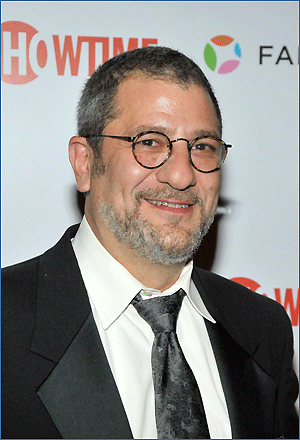
Backstory
Manos avoided a career in pro basketball when he realized that at 5’ 10” he was going to have to work too hard to keep up with the other players. He went into acting, did summer stock, and wound up at the Royal Academy of Dramatic Arts in London.
He says he “wasn’t intending to be an actor,” but “it’s imperative to know what you’re asking someone to do.” (I found the same thing: one of the most useful writing and directing classes I took was two years at the Joanne Baron Studio studying Meisner Technique acting. I didn’t want to act either, but it taught me a lot about how scenes work, and it helps me listen to my characters.)
I would not necessarily be surprised if he was eliding a few fits and starts here – no one likes to talk about things that didn’t work – but soon he read about a Texas mom who allegedly tried to help her daughter get on the cheerleading squad by hiring a hit man to kill her daughter’s rival’s mom. Figuring he was never going to get into Hollywood unless he had something that everyone else wanted, he “borrowed $150,000 from a friend” and went down to Channelview Texas, wondering if there was something in the air that made everyone down there nuts. He was surprised to discover the town flooded with limousines – Hollywood producers who were also down there to buy the story. But he got the rights.
If I scribbled this down correctly, he wrote up a 20 page treatment and took it to Bob Cooper at HBO, who immediately optioned it, and they hired a writer, and Manos was off to the races – as a producer.
To be continued...
Tuesday, July 21, 2009
Morgenstern and Ellis on FLASHPOINT
Stephanie Morgenstern and Mark Ellis are the creators of FLASHPOINT, and extremely nice people. I planned to interview them at the Banff Worldwide Television Festival, but they tricked me by asking me all about my projects for twenty minutes, leaving me only ten minutes to ask them my questions. Fortunately, they very kindly followed up with me by email. So this is a mix of the questions I was able to ask, my notes from the Master Class they gave with their CBS exec, Christina Davis, Senior Vice President for Drama Series Development, and their additions to my transcript.
 The idea for FLASHPOINT originated with a hostage taking in Toronto's Union Station in 2004. As Morgenstern and Ellis relate, "We watched it unfold in real time. And in the end, the gunman was shot. And we wondered, what is the rest of the day going to be like for the police offier who took that shot? We'd seen lots of films about criminals and detectives and victims, but rarely the SWAT officers. They're usually just anonymous guys who show up at the last minute, shoot the bad guy, and walk away."
"At the time we were making plans to adapt a short film into a feature - our writing wasn't very TV oriented. We happened to have a meeting with our agents the morning of the Union Station incident, and Lesley Harrison started to think about about its possibilities as a MOW. She made a call to CTV that day and that got the ball rolling. After a few weeks of thinking and research we pitched it over coffee to Lesley Grant. She was intrigued and asked for a one-pager."
From there, the project rose up the pile to a potential series, with exec producer Anne-Marie La Traverse its first real champion. "We had to compress a two hour movie of the week into a one hour series pilot."
"We didn't set out with the goal of making a border-crossing product. It was about the story. We were just curious: what is life like behind the ballistic shield? What is the messy, complicated, human thing that breaks your heart when you have to take someone’s life? This was our point of departure. This is what was keeping us up at night.
"We met a cop, Jimmy Bremner, who had been involved with a couple of shootings. Jimmy was the team leader in a hostage taking incident. And he told us, if you can get a hostage taker talking past his deadline, your odds go up a lot for a peaceful resolution. And they'd got this guy talking past his deadline, but then suddenly he raised his gun and aimed it at the police negotiator. Jimmy had to shoot him from 2 meters away. It was the first time he’d had to shoot somebody. And he was back on the job the next morning.
"There was a domestic dispute two days later. And he got into a struggle with a guy. And suddenly there was blood on his hands, and he realized he'd shot the man.
"It's a rule of thumb that if an officer doesn't get treatment within 48 hours of shooting someone, or takes a drink in those 48 hours, then he's in trouble. Jimmy went through some really tough times before he came out on the other side and his stories went on to inspire some of our stories. The obstacles he faced felt to us like the heart of a TV show. The challenge then became, how do you create a mainstream net procedural show that is going to maintain that level of inner interest and passion along the way?
"As a policeman, you're three times more likely to die of violence from your own hand than on the job. It's safer being at work than being alone with your thoughts. How do you go home at the end of the day?
 "So with Anne Marie La Traverse producing, we had a completed pilot which set the tone, the premise, the characters, the world of the show - and its very ambitious, polished look. It was at this point that CTV's Bill Mustos was returning from a sabbatical, and he made the decision to step outside CTV and become a creative producer. Anne Marie teamed up with him and they became the creative-producing engine that set up the foundations with us for full-fledged series. Working closely with CTV we created a package to go with the pilot: full character profiles, premises for future episodes, etc. And it included a second completed script, "First in Line," which established the show's long-term template in a way that the pilot didn't - i.e. one crisis per week, framed by team activity at the station before and after, a montage denouement underscored by Canadian singer-songwriter talent...
We were drawn to RESCUE ME. The show is sort of RESCUE ME with cops, though we don't go into the family life so much. There's darkness, but there's redemption. At the same time, we were watching CSI — single serving shows. And we wanted to stay within the realm of the broadcast network wheelhouse. We wanted to be mostly episodic while finding a way to reward the frequent flyers.
"This was already very close to the writer’s strike in the States. At this point Bill and Anne Marie took it across the border."
Christina Davis continues:
"The writer’s strike started Nov 1, 2007. And the networks were all shocked. And we jumped into, what are we going to do if the strike goes a year? We were looking at every international format: New Zealand, Israel, the UK, Australia. Really canvassing the creative community globally. I developed a relationship with [Executive Producer] Bill Mustos. He said, "I have a filmed pilot." And we watched the pilot and it just clicked. This particular angle had a unique emotional hook — the personal cost of heroism. And Enrico Colantani was someone American audiences are familiar with.
"As a Canadian show, it was strike-proof. And with a beneficial financial model, it was really a no-brainer. But it started because of the creative angle.
"It came to us in a very convenient situation, where they'd already filmed the pilot so you could see the production value, but they weren't so far along that we couldn't have any creative input. The content fit so perfectly, we were able to see a pilot which was really unique, but you guys hadn't moved so far forward that we couldn't be part of it. You had a CTV order, so there was something we could jump on board with. We did a bit of recasting... The tendency is when you go too far down the road, we're not able to collaborate you, but this was an open valley.
"It took place in Toronto, but they didn't make a meal of it, so that worked for us.
"So we said, okay, we need this as soon as possible. We struck the deal in January '08, they started production in April, and we were on the air by July. We had 8.7 million viewers for the US premiere, which worked its way down to 6 million on average over the season. It's working well on Friday nights."
Q. What are some of the things you learned from your experience?
Morgenstern/Ellis: One of the buzzwords in the room was something we got from Christina, which was, "all of your first six episodes should be pilot episodes". In other words, you have to keep re-introducing the core characters.
Another expression we used was using the "eyedropper." We picked this up from Dick Wolf, as seen on LAW & ORDER: you get to know your regulars at the same pace as you do real people, a little more each day, instead of in huge chunks of backstory exposition. You do it by 'eyedropper' rather than by 'soup ladle.'
For example, at the end of our bottle show, we show Ed going home, and inside his garage he's got a secret locker filled with articles and press clippings and souvenirs of every screwup, everything near miss where he almost got somebody hurt. And his wife comes in unexpectedly, and instead of shutting it, he thinks a sec, then opens it for her to see for the first time. We play the whole thing silently. A moment like that can take the place of a monologue.
Q. What do you think about Canadian government support for TV?
M/E: We are really public funding babies. We've been supported by everyone from the Canada Council to Telefilm to the OMDC to Women in the Director's Chair. And that has opened so many doors. Doing the short film — every step of our careers was supported by emerging artist support. And we come from Canadian theatre, where actors are often involved in workshopping new plays. We even met doing Fringe Theatre — public funding makes all of those possible.
Stephanie Morgenstern: It might look like this all happened very suddenly - out of nowhere these two actors suddenly know how to write a TV show. But it's not true. We're part of a culture that cares about the arts, and we would be nowhere without that support. Grants make career growth possible. So "should we be investing in Canadian television?" Absolutely. It wouldn't exist without that support. And we have to not only invest in television funding, but also in grass-roots artist support. That's the research and development branch of the business.
Mark Ellis: And there's a message buried in FLASHPOINT that I think is very Canadian: let's keep the peace. We're comfortable with that as Canadians. We're a nation of peacekeepers. Canada is a model for nonfatal outcomes. The show is about trying to understand what's going on, and using confrontation only as a last resort.
Stephanie Morgenstern: The show conspicuously takes place in Toronto, though we tend not to refer to it by name, any more than real Torontonians do on an average day. We use Toronto locations and landmarks and street names, and the mailboxes are red. The uniforms have little Canadian flags on the shoulders. Most of us Canadian actors who get cast in American shows that shoot up here have had to train ourselves to say "praw-cess" instead of "pro-cess", or "saw-ree" instead of "so-ree." Well, we had a Canadian actress on Flashpoint who'd worked a great deal in LA, and I noticed that by habit, she was doing the American version of "sorry." It was a real pleasure to whisper to the script assistant to let her know her, "It's OK to say "So-ree."
Mark Ellis: And we had a scene where one character sends another out to Timmy's for a double-double.
[Note: It was interesting to hear Stephanie and Mark talk about how proud they were about the Canadiana that they were able to put in the show, while from Christina Davis's point of view, it was good that they "didn't make a meal of it." It makes sense, though: the Canadian audience doesn't need maple syrup to know a show is in Canada, while the Americans aren't going to notice the references to Yonge Street and Tim Horton's. So long as you don't put up too many portraits of the Queen, all the local color just reads to Americans as flavor.]
Q. As you took the project from concept to MOW, to pilot, to series, who was guiding you?
Mark Ellis: Tassie Cameron came aboard during the transition from pilot to series. She has a tremendous experience in Canadian TV. She's a fantastic human being and understood the show. The way the show is structured, there's no single showrunner as the voice of the show. That's a bit rocky when there is conflict. But it means we've been able to retain a lot of say in the process. We get the final rewrite on every episode.
Christina Davis: CBS was a little more nervous launching the show not knowing who the showrunner was and their experience. Bill Mustos and Anne Marie La Traverse are such creatives, but on the American iside it all goes back to the idea and the writer. And an idea is an idea, but who's going to execute it, and create a template for the life of the series, which hopefully is 150 episodes. But with Tassie Cameron coming in, we had a comfort level. Those 13 episodes gave us a great opportunity to understand you guys [Stephanie and Mark] better, how you stepped up as a producers. Now she's on to other projects, we'll let you figure out how to work it out.
Q. You started as actors. What made you decide to write?
Mark Ellis: It was never a decision to start writing as such. We came across a true story that Stephanie and I wanted to turn into a short film — it wasn't "I want to be a writer," but "I have a story I'm burning to tell." This was "Remembrance," which is in development as a feature.
Q. What lessons have you learned about the craft of making TV from your experience working with an American network? Or to put it another way, what do you feel Canadians can learn from the American system, to the extent you’ve been exposed to it.
Mark Ellis: We're learning as we go along, to keep re-rooting yourself in the vision of the show. To stay true to your voice. Personalities and execs will change, but the creative is the constant in the show.
Of course it’s your job to be open to notes and direction and you must consider every scrap of wisdom. And the first time you're on a call with CBS, you think, "I'm on a call with CBS!" It takes a while to get over that.
Stephanie Morgenstern: They bring a vast amount of experience and context to the notes and ideas that they offer. Over time, though, you also develop a sense of them as human beings, and you learn to trust your own judgment in that mix, to get past the surface, and find the essence of what they're saying... and of course to find an organic balance with the notes of the other network.
Mark Ellis: The collaborative process is ingrained. We were never the kinds of writers who never wanted anything changed. We've workshopped plays. And, like theatre, TV is extraordinarily collaborative. So a good position to take is to be humble and yet to stay true to a vision. We're not confrontational. I know there are US showrunners who are confrontational, who will kick chairs... and maybe we’ll get to that... (They laugh.)
The idea for FLASHPOINT originated with a hostage taking in Toronto's Union Station in 2004. As Morgenstern and Ellis relate, "We watched it unfold in real time. And in the end, the gunman was shot. And we wondered, what is the rest of the day going to be like for the police offier who took that shot? We'd seen lots of films about criminals and detectives and victims, but rarely the SWAT officers. They're usually just anonymous guys who show up at the last minute, shoot the bad guy, and walk away.""At the time we were making plans to adapt a short film into a feature - our writing wasn't very TV oriented. We happened to have a meeting with our agents the morning of the Union Station incident, and Lesley Harrison started to think about about its possibilities as a MOW. She made a call to CTV that day and that got the ball rolling. After a few weeks of thinking and research we pitched it over coffee to Lesley Grant. She was intrigued and asked for a one-pager."
From there, the project rose up the pile to a potential series, with exec producer Anne-Marie La Traverse its first real champion. "We had to compress a two hour movie of the week into a one hour series pilot."
"We didn't set out with the goal of making a border-crossing product. It was about the story. We were just curious: what is life like behind the ballistic shield? What is the messy, complicated, human thing that breaks your heart when you have to take someone’s life? This was our point of departure. This is what was keeping us up at night.
"We met a cop, Jimmy Bremner, who had been involved with a couple of shootings. Jimmy was the team leader in a hostage taking incident. And he told us, if you can get a hostage taker talking past his deadline, your odds go up a lot for a peaceful resolution. And they'd got this guy talking past his deadline, but then suddenly he raised his gun and aimed it at the police negotiator. Jimmy had to shoot him from 2 meters away. It was the first time he’d had to shoot somebody. And he was back on the job the next morning.
"There was a domestic dispute two days later. And he got into a struggle with a guy. And suddenly there was blood on his hands, and he realized he'd shot the man.
"It's a rule of thumb that if an officer doesn't get treatment within 48 hours of shooting someone, or takes a drink in those 48 hours, then he's in trouble. Jimmy went through some really tough times before he came out on the other side and his stories went on to inspire some of our stories. The obstacles he faced felt to us like the heart of a TV show. The challenge then became, how do you create a mainstream net procedural show that is going to maintain that level of inner interest and passion along the way?
"As a policeman, you're three times more likely to die of violence from your own hand than on the job. It's safer being at work than being alone with your thoughts. How do you go home at the end of the day?
"So with Anne Marie La Traverse producing, we had a completed pilot which set the tone, the premise, the characters, the world of the show - and its very ambitious, polished look. It was at this point that CTV's Bill Mustos was returning from a sabbatical, and he made the decision to step outside CTV and become a creative producer. Anne Marie teamed up with him and they became the creative-producing engine that set up the foundations with us for full-fledged series. Working closely with CTV we created a package to go with the pilot: full character profiles, premises for future episodes, etc. And it included a second completed script, "First in Line," which established the show's long-term template in a way that the pilot didn't - i.e. one crisis per week, framed by team activity at the station before and after, a montage denouement underscored by Canadian singer-songwriter talent...We were drawn to RESCUE ME. The show is sort of RESCUE ME with cops, though we don't go into the family life so much. There's darkness, but there's redemption. At the same time, we were watching CSI — single serving shows. And we wanted to stay within the realm of the broadcast network wheelhouse. We wanted to be mostly episodic while finding a way to reward the frequent flyers.
"This was already very close to the writer’s strike in the States. At this point Bill and Anne Marie took it across the border."
Christina Davis continues:
"The writer’s strike started Nov 1, 2007. And the networks were all shocked. And we jumped into, what are we going to do if the strike goes a year? We were looking at every international format: New Zealand, Israel, the UK, Australia. Really canvassing the creative community globally. I developed a relationship with [Executive Producer] Bill Mustos. He said, "I have a filmed pilot." And we watched the pilot and it just clicked. This particular angle had a unique emotional hook — the personal cost of heroism. And Enrico Colantani was someone American audiences are familiar with.
"As a Canadian show, it was strike-proof. And with a beneficial financial model, it was really a no-brainer. But it started because of the creative angle.
"It came to us in a very convenient situation, where they'd already filmed the pilot so you could see the production value, but they weren't so far along that we couldn't have any creative input. The content fit so perfectly, we were able to see a pilot which was really unique, but you guys hadn't moved so far forward that we couldn't be part of it. You had a CTV order, so there was something we could jump on board with. We did a bit of recasting... The tendency is when you go too far down the road, we're not able to collaborate you, but this was an open valley.
"It took place in Toronto, but they didn't make a meal of it, so that worked for us.
"So we said, okay, we need this as soon as possible. We struck the deal in January '08, they started production in April, and we were on the air by July. We had 8.7 million viewers for the US premiere, which worked its way down to 6 million on average over the season. It's working well on Friday nights."
Q. What are some of the things you learned from your experience?
Morgenstern/Ellis: One of the buzzwords in the room was something we got from Christina, which was, "all of your first six episodes should be pilot episodes". In other words, you have to keep re-introducing the core characters.
Another expression we used was using the "eyedropper." We picked this up from Dick Wolf, as seen on LAW & ORDER: you get to know your regulars at the same pace as you do real people, a little more each day, instead of in huge chunks of backstory exposition. You do it by 'eyedropper' rather than by 'soup ladle.'
For example, at the end of our bottle show, we show Ed going home, and inside his garage he's got a secret locker filled with articles and press clippings and souvenirs of every screwup, everything near miss where he almost got somebody hurt. And his wife comes in unexpectedly, and instead of shutting it, he thinks a sec, then opens it for her to see for the first time. We play the whole thing silently. A moment like that can take the place of a monologue.
Q. What do you think about Canadian government support for TV?
M/E: We are really public funding babies. We've been supported by everyone from the Canada Council to Telefilm to the OMDC to Women in the Director's Chair. And that has opened so many doors. Doing the short film — every step of our careers was supported by emerging artist support. And we come from Canadian theatre, where actors are often involved in workshopping new plays. We even met doing Fringe Theatre — public funding makes all of those possible.
Stephanie Morgenstern: It might look like this all happened very suddenly - out of nowhere these two actors suddenly know how to write a TV show. But it's not true. We're part of a culture that cares about the arts, and we would be nowhere without that support. Grants make career growth possible. So "should we be investing in Canadian television?" Absolutely. It wouldn't exist without that support. And we have to not only invest in television funding, but also in grass-roots artist support. That's the research and development branch of the business.
Mark Ellis: And there's a message buried in FLASHPOINT that I think is very Canadian: let's keep the peace. We're comfortable with that as Canadians. We're a nation of peacekeepers. Canada is a model for nonfatal outcomes. The show is about trying to understand what's going on, and using confrontation only as a last resort.
Stephanie Morgenstern: The show conspicuously takes place in Toronto, though we tend not to refer to it by name, any more than real Torontonians do on an average day. We use Toronto locations and landmarks and street names, and the mailboxes are red. The uniforms have little Canadian flags on the shoulders. Most of us Canadian actors who get cast in American shows that shoot up here have had to train ourselves to say "praw-cess" instead of "pro-cess", or "saw-ree" instead of "so-ree." Well, we had a Canadian actress on Flashpoint who'd worked a great deal in LA, and I noticed that by habit, she was doing the American version of "sorry." It was a real pleasure to whisper to the script assistant to let her know her, "It's OK to say "So-ree."
Mark Ellis: And we had a scene where one character sends another out to Timmy's for a double-double.
[Note: It was interesting to hear Stephanie and Mark talk about how proud they were about the Canadiana that they were able to put in the show, while from Christina Davis's point of view, it was good that they "didn't make a meal of it." It makes sense, though: the Canadian audience doesn't need maple syrup to know a show is in Canada, while the Americans aren't going to notice the references to Yonge Street and Tim Horton's. So long as you don't put up too many portraits of the Queen, all the local color just reads to Americans as flavor.]
Q. As you took the project from concept to MOW, to pilot, to series, who was guiding you?
Mark Ellis: Tassie Cameron came aboard during the transition from pilot to series. She has a tremendous experience in Canadian TV. She's a fantastic human being and understood the show. The way the show is structured, there's no single showrunner as the voice of the show. That's a bit rocky when there is conflict. But it means we've been able to retain a lot of say in the process. We get the final rewrite on every episode.
Christina Davis: CBS was a little more nervous launching the show not knowing who the showrunner was and their experience. Bill Mustos and Anne Marie La Traverse are such creatives, but on the American iside it all goes back to the idea and the writer. And an idea is an idea, but who's going to execute it, and create a template for the life of the series, which hopefully is 150 episodes. But with Tassie Cameron coming in, we had a comfort level. Those 13 episodes gave us a great opportunity to understand you guys [Stephanie and Mark] better, how you stepped up as a producers. Now she's on to other projects, we'll let you figure out how to work it out.
Q. You started as actors. What made you decide to write?
Mark Ellis: It was never a decision to start writing as such. We came across a true story that Stephanie and I wanted to turn into a short film — it wasn't "I want to be a writer," but "I have a story I'm burning to tell." This was "Remembrance," which is in development as a feature.
Q. What lessons have you learned about the craft of making TV from your experience working with an American network? Or to put it another way, what do you feel Canadians can learn from the American system, to the extent you’ve been exposed to it.
Mark Ellis: We're learning as we go along, to keep re-rooting yourself in the vision of the show. To stay true to your voice. Personalities and execs will change, but the creative is the constant in the show.
Of course it’s your job to be open to notes and direction and you must consider every scrap of wisdom. And the first time you're on a call with CBS, you think, "I'm on a call with CBS!" It takes a while to get over that.
Stephanie Morgenstern: They bring a vast amount of experience and context to the notes and ideas that they offer. Over time, though, you also develop a sense of them as human beings, and you learn to trust your own judgment in that mix, to get past the surface, and find the essence of what they're saying... and of course to find an organic balance with the notes of the other network.
Mark Ellis: The collaborative process is ingrained. We were never the kinds of writers who never wanted anything changed. We've workshopped plays. And, like theatre, TV is extraordinarily collaborative. So a good position to take is to be humble and yet to stay true to a vision. We're not confrontational. I know there are US showrunners who are confrontational, who will kick chairs... and maybe we’ll get to that... (They laugh.)
Wednesday, December 05, 2007
Banff Registration -- Rookie Rate
The Banff Worldwide Television Festival has opened its virtual ticket office. The first 100 registrants who haven't already come to Banff are eligible for the Rookie Rate. It's $1000, but that's a sight cheaper than the Early Bird rate of $1425 or the regular festival rate of $2125.
The Banff TV Festival is a great opportunity to meet Canadian producers and network executives. The first time I went, I had thirty set meetings in four days, not counting people I met in the halls and in the bar. Producers and network executives are more willing to meet you (being at Banff means you're serious), and there are also Face to Face programs and Breakfast /Cocktails/Dinners with Dealmakers where you can sign up to sit with execs for ten minutes whether they're interested in meeting you or not.
And lots of parties.
And you are in the absolutely stunning town of Banff Springs, with the Canadian Rockies all around you.
If you're in the Canadian industry, I consider Banff a can't-miss appointment. This year I hope to interview some of the writers who come to give master classes -- stay tuned.
The Banff TV Festival is a great opportunity to meet Canadian producers and network executives. The first time I went, I had thirty set meetings in four days, not counting people I met in the halls and in the bar. Producers and network executives are more willing to meet you (being at Banff means you're serious), and there are also Face to Face programs and Breakfast /Cocktails/Dinners with Dealmakers where you can sign up to sit with execs for ten minutes whether they're interested in meeting you or not.
And lots of parties.
And you are in the absolutely stunning town of Banff Springs, with the Canadian Rockies all around you.
If you're in the Canadian industry, I consider Banff a can't-miss appointment. This year I hope to interview some of the writers who come to give master classes -- stay tuned.
Tuesday, May 01, 2007
Pitching at Banff
Looks like a friend of mine's and my pitch is in at the Banff Youth Pitchit! program. That's where you pitch for five minutes in front of 150-250 showbiz people. Yikes. This one is a simpler concept than the one I pitched last year. And my friend and colleague is a veteran pitcher and showrunner. Not to mention charismatic as all get out. So this should be sheer joy and fun, no stress at all. Right?
Friday, April 13, 2007
Pitching Networks
Q. We're coming to Banff armed with (a) a spec episode of a current show and a comedy feature, to show as writing samples, because (b) we've also got a couple of shows we've developed and we're looking for network or producer interest in them.Attaching a strong producer is a definite plus. Networks will often agree to read your material whether you have credits or not, but my experience is they don't read it as seriously. Often the pitch just disappears. The right producer validates your pitch and makes up for your inexperience.
So, my two-fold question is:
1) Is it possible to make a deal for a show with a network without produced credits or are we only likely to get something done if we get a legitimate producer with a track record attached first, perhaps while in Banff?
Q. 2) I'm not sure what kind of documents to come armedI generally like a 3-6 page pitch doc that says what the show is. That way the exec I meet can pass it up the chain; otherwise it's just the exec's recap that gets passed up the chain. Also, it's easier to prove it was your idea. A good friend of mine who's a veteran writer uses one page leave behinds. But I like to work out more of the details of a show before I pitch it. Working up 3-6 pages forces me to come up with springboards, that forces me to nail down the relationships, and I often discover (and hopefully fix) problems when I have to do that.
with for a show. Is a simple two-page leave-behind going to be enough? Or do we need more comprehensive documentation? You mention a 20-page pitch document you put together last year...?
Saturday, March 31, 2007
Pitching at PitchIt
Chris writes:
Needless to say, not how pitching usually happens.
I submitted four pitches last year, and one got into the program. I didn't win, so I can't claim any special brilliance there.
What gets you into the program, I have to imagine, is a good 750 word pitch. To me that means about 300 words on what your show is; 250 words on who your characters are; and 200 possibly story ideas. They don't have to be in sections like that, but for most shows that's the simplest and cleanest presentation.
I memorized a four-minute pitch down the word, honing it constantly, and pitching it to anyone who would give me four minutes. I thought it came off well. I did lousy at the Q & A, though. I didn't understand what one of the judges was asking, so instead of answering the question in two sentences, I rambled on incoherently.
That's okay. I eventually set up the project in development at a cable network here, with a 20 page pitch that answered pretty much every damn question anyone ever asked me when I pitched them, including the one I bobbled at PitchIt!
What were the others, lessee ... A comedy about a heavy metal band that performs for kids ... A comic procedural about health inspectors ... a comedy about two drunken louts who used to be the Hardy Boys and now solved mysteries about their missing beer can and the like ... can't remember the last one. I thought Sarah Timmins' health inspector show was the best pitch among the others (obviously I have no perspective on my own). The Hardy Boys guys did some schtick onstage and then showed a trailer they'd shot. The heavy metal guy seemed a little shaggy, and so did his pitch, but he won the prize and the audience prize, so there you go.
Personally I'd stay away from theatrics. I don't want to be judged on how well I bring off the theatrics. I want to be judged on the value of my idea. And if you have a great idea, all it needs is for your to explain it coherently and cleanly. If you don't, no amount of theatrics will rescue it.
My pitch was fairly complex, so I spent about two months moving bits around and trying them out over and over to see if they would go into people's brains better. I started with an image, then my main character, then her problem, and expanded from there. I ended on a mystery, and my theme. I was doing other things during those two months, but whenever I had a spare moment I worked on my pitch. I practiced it while I went running. I pitched it to absolute strangers. I pitched it to my (then) 10 year old son.
(As a side note, it is always a good idea to pitch your idea to a fifth grader. If there's anything he can't understand, the odds are excellent your story is too complicated.)
The biggest question you need to answer in any pitch is, I think: how is this a series. An obvious question, you'd think, but not all of the pitches answered it well. Some of the ideas seemed good for a show, or maybe even five shows. But 100 shows? If you can't explain out how you're going to come up with ideas for at least three seasons, then maybe your idea isn't a tv show.
I'll be submitting a couple of things to PitchIt! this year too. Whether or not your pitch wins, you get a lot of exposure pitching in front of a huge crowd like that, and it structures your visit to the Rockies. It might help you get the show set up, but expect for it to take six months to a year to get anything solid out of your Banff trip.
Good luck, and hope to see you at the podium!
Q. I read through some of your entries from last year about your pitching at Banff and I have a few questions. I'm considering entering the PitchIt! dealie and wanted to know what makes a winning pitch. What's the difference between a winning pitch and a not-winning pitch, is it theatrics? Quality of the show? A clever balance of both? What are some pitch do's and don'ts? How long do pitches usually run and is their running time mandated? How should I structure my pitch? What would you have done differently in your pitch?The PitchIt! program is an event at Banff where creators (including creator teams) pitch their idea to an audience of 150+ people. To pitch, you submit 750 words on your idea, and 300 words on you or your team, and the best five are selected. At the pitch, you get 4 minutes to say or do whatever you like, and then a few more minutes to answer questions from the panel of judges, who are network execs.
Needless to say, not how pitching usually happens.
I submitted four pitches last year, and one got into the program. I didn't win, so I can't claim any special brilliance there.
What gets you into the program, I have to imagine, is a good 750 word pitch. To me that means about 300 words on what your show is; 250 words on who your characters are; and 200 possibly story ideas. They don't have to be in sections like that, but for most shows that's the simplest and cleanest presentation.
I memorized a four-minute pitch down the word, honing it constantly, and pitching it to anyone who would give me four minutes. I thought it came off well. I did lousy at the Q & A, though. I didn't understand what one of the judges was asking, so instead of answering the question in two sentences, I rambled on incoherently.
That's okay. I eventually set up the project in development at a cable network here, with a 20 page pitch that answered pretty much every damn question anyone ever asked me when I pitched them, including the one I bobbled at PitchIt!
What were the others, lessee ... A comedy about a heavy metal band that performs for kids ... A comic procedural about health inspectors ... a comedy about two drunken louts who used to be the Hardy Boys and now solved mysteries about their missing beer can and the like ... can't remember the last one. I thought Sarah Timmins' health inspector show was the best pitch among the others (obviously I have no perspective on my own). The Hardy Boys guys did some schtick onstage and then showed a trailer they'd shot. The heavy metal guy seemed a little shaggy, and so did his pitch, but he won the prize and the audience prize, so there you go.
Personally I'd stay away from theatrics. I don't want to be judged on how well I bring off the theatrics. I want to be judged on the value of my idea. And if you have a great idea, all it needs is for your to explain it coherently and cleanly. If you don't, no amount of theatrics will rescue it.
My pitch was fairly complex, so I spent about two months moving bits around and trying them out over and over to see if they would go into people's brains better. I started with an image, then my main character, then her problem, and expanded from there. I ended on a mystery, and my theme. I was doing other things during those two months, but whenever I had a spare moment I worked on my pitch. I practiced it while I went running. I pitched it to absolute strangers. I pitched it to my (then) 10 year old son.
(As a side note, it is always a good idea to pitch your idea to a fifth grader. If there's anything he can't understand, the odds are excellent your story is too complicated.)
The biggest question you need to answer in any pitch is, I think: how is this a series. An obvious question, you'd think, but not all of the pitches answered it well. Some of the ideas seemed good for a show, or maybe even five shows. But 100 shows? If you can't explain out how you're going to come up with ideas for at least three seasons, then maybe your idea isn't a tv show.
I'll be submitting a couple of things to PitchIt! this year too. Whether or not your pitch wins, you get a lot of exposure pitching in front of a huge crowd like that, and it structures your visit to the Rockies. It might help you get the show set up, but expect for it to take six months to a year to get anything solid out of your Banff trip.
Good luck, and hope to see you at the podium!
Subscribe to:
Posts (Atom)